📖 《把 AI 当助手——经济实证研究的诚信、方法与工具》双语网页版:每章中文部在前,English Edition 在后,内容与最新合订 PDF 一致。
第0章 · 研究诚信开篇:从科学方法论到 AI 时代研究者守则
本章从“科学是什么”这一最基本的问题出发,沿“自然科学→社会科学→经济学→金融研究”的层级逐步展开,论证经济学作为社会科学的科学属性,并以 Wallace(1971)科学环为骨架,把 AI 时代的研究诚信边界一一标清。它不教一行代码,也不跑一个回归,但会帮你建立一套“判断什么能做、什么绝不能做”的底层逻辑。
学习目标
完成本章后,你应当能够:
说出科学研究与传统知识获取(经验、信念、权威)的根本区别
画出 Wallace(1971)科学环,并在每个环节标出 AI 的「增强点」与「风险点」。
识别教育部 40 号令规定的七种剽窃情形,以及 AI 时代新增的五类不端行为。
复述本手册的五条终极建议,并说出每条对应的规范文件。
0.1 为什么做研究必须先讲诚信
许多同学踏入研究生第一年就被“学术诚信”四个字反复“教育”,觉得是老生常谈。但本手册的诚信开篇与一般入学教育的视角不同——我们不是从“道德说教”切入,而是从“科学方法论的内在要求”切入。本章先用 0.2 节把“经济学是不是科学”这个底层问题讲清楚,再回到诚信本身——这样,“做研究必须诚实”就不仅仅是口号,而是科学方法论对研究者提出的硬约束。
诚信的代价并非抽象概念。下面三个真实案例,牵涉顶刊、博士学位和高校管理干部——看完你会发现:讲诚信不是口号,而是会在某一天真实地决定你能不能拿到学位、能不能保住工作的硬约束。
案例一 · 顶刊撤稿:「耿同学讲故事」打假《Nature》系论文事件(2026)
事件:2026 年 4—5 月,科普博主「耿同学讲故事」公开质疑一篇发表在《Nature》子刊上的论文存在图像与数据问题,视频迅速发酵,惊动全网。新华社随后展开深度调查报道(2026.5.26),央广网以「为什么惊动全网」为题跟进(2026.5.27)。
后果:涉事论文进入期刊调查与撤稿程序,相关作者的学术声誉受到严重冲击,其所在机构的科研诚信管理被推到舆论风口。
启示:顶刊光环不是「免检金牌」。在开放科学和全网复检的时代,任何一张图、一组数据都可能被无数双眼睛重新审视。数据与图片必须真实、可溯源、可复现——这一条,AI 替你「补」不出来,也不该让 AI 去「补」。
案例二 · 学位撤销:翟天临事件(2019)
事件:2019 年 2 月,演员翟天临在直播中被问及论文时反问「知网是什么」,引发网友对其学术背景的质疑。随后其已发表论文被检出大面积抄袭,北京电影学院于 2019.2.19 发布通报(人民网报道)。
后果:北京电影学院撤销其博士学位,北京大学光华管理学院撤销其博士后出站资格。一顶已经戴上多年的博士帽,被追回。
启示:学术不端没有「过期作废」。随着学位法的实施,学位论文出现学术不端可以终身追责。
案例三 · 免职撤衔:西南地区CD大学学院党委书记抄袭事件(2026)
事件:2026 年 8—9 月,媒体披露 CD 大学某学院党委书记的 15 万字专著存在大篇幅抄袭,其两篇英文论文亦被检出虚假引用;校方 2026.9.1 通报成立调查组(观察者网、新华社报道)。
后果:2026.9.30 校方发布处理通报:经专家调查组核查认定构成学术不端,免去其学院党委书记职务,撤销正高级专业技术职务任职资格,取消科研项目申报、职称评定、评奖评优等资格 36 个月,记入科研诚信严重失信行为数据库;驻校纪检监察组立案审查(新华社 2026.9.30 报道)。
启示:诚信面前没有职务高低。无论你是普通学生,还是身居管理岗位的干部,一旦查实学术不端,处理标准是一致的——从免职、撤销职称到失信库留痕,代价贯穿整个职业生涯。
这三个案例有一个共同点:它们都不是「能力不足」的失败,而是研究流程中某一个环节失守的结果——论文中的图片没核实、引用没查证、署名不诚实、数据来源说不清。而研究流程,正是这本手册要带你一环一环走通的东西。
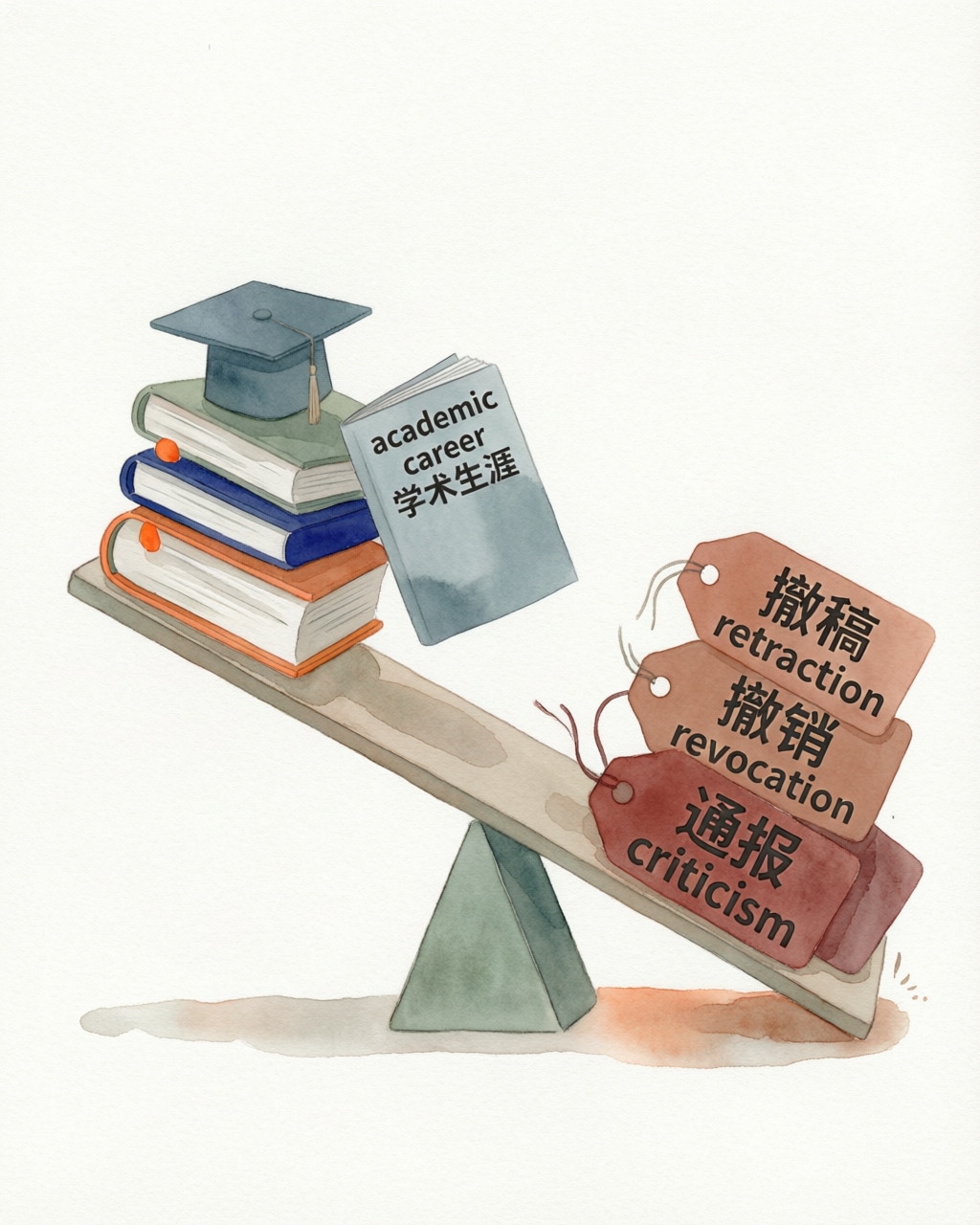
图 0.1 诚信天平——学术资产与三个警示标签的失衡。
0.2 从科学到经济学:研究方法论的层级与传承
在讲诚信之前,得先回答一个底层问题:经济学是不是科学? 本节沿“自然科学→社会科学→经济学→金融研究”的层级展开论证。习近平同志在《在哲学社会科学工作座谈会上的讲话》[80]中明确指出:“一个没有发达的自然科学的国家不可能走在世界前列,一个没有繁荣的哲学社会科学的国家也不可能走在世界前列。”这一定位意味着:包括经济学在内的哲学社会科学,其科学属性是一个需要正面回应、而不是回避的问题。
科学知识从哪里来
「科学」定义为「在使用科学方法的领域中所包含的有组织的系统化知识」。它区别于我们日常获取知识的其他方式:
经验直觉:「我做投资二十年了,凭感觉成都南边的房价还得涨」——可能对,但是你无法告诉别人你是怎么得出的这一结论。
权威断言:「某专家说会涨」——你无法独立复核,专家错了也无人追责。
信念信仰:无法被观测或证伪,不属于科学范畴。
而科学知识,是「通过科学方法获取的、用于解释现象或行为的一系列规律和理论」。它靠两根支柱站立:逻辑(理论)与证据(观察),二者相互依赖、缺一不可。
科学知识的三个特征
可证伪性:理论必须以「能被推翻」的方式提出。一个怎么说都对、永远无法被证伪的说法,不是科学。
可复制性:别人能用同样的方法独立重做,得到相同或相似的结果。这正是经济金融研究中强调「代码 + 数据可复现」的原因。
自我修正性(精简性 + 后实证主义):科学不追求一次到位的绝对真理,而是在「差的理论→好的理论」之间螺旋上升,用最简洁的解释(奥卡姆剃刀)不断逼近现实。
预告:「探索 / 描述 / 解释」三种研究目的将在第 4 章具体化为可操作的研究设计。
社会科学:研究“人”与“社会”的科学
社会科学是以社会现象为对象、以“人及其社会行为”为研究客体的学科群——经济学、社会学、政治学、法学、教育学、管理学等都属此列。它与自然科学的差异主要在研究对象的复杂性,而非方法论的根本不同:
学科属性:研究对象是“人的行为及其社会结构”,与自然科学的“自然现象”不同。但研究方法论共享同一支柱——**逻辑(理论)+证据(观察)**的双重验证。
马克思主义哲学高度:《求是》2024 年第 3 期陈雨露《加快构建中国特色哲学社会科学》[81]明确指出:“马克思主义关于世界的物质性及其发展规律、人类社会及其发展规律、认识的本质及其发展规律等原理,为我们研究把握哲学社会科学各个学科各个领域提供了基本的世界观、方法论。”这是从马克思主义哲学高度对社会科学的科学属性的权威背书。
自主知识体系:习近平同志 2022 年在中国人民大学考察时强调:“加快构建中国特色哲学社会科学,归根结底是建构中国自主的知识体系”[82]。这是从顶层对哲学社会科学工作提出的战略目标,也是本手册后续方法主线的政策背景。
经济学作为社会科学的科学属性
经济学是社会科学的核心分支,其科学属性可从三方面论证:
逻辑(理论)支柱:从稀缺性假设出发,经演绎推出可检验的命题——这与 Wallace(1971)科学环的“理论→假设”路径完全吻合。从 Adam Smith 的“看不见的手”、到 Marshall 的局部均衡分析、再到现代一般均衡理论(Arrow–Debreu),演绎链条一脉相承。
证据(观察)支柱:从 Smith《国富论》的劳动分工观察,到 Keynes《就业、利息与货币通论》的有效需求经验研究,再到现代金融学的资产定价模型与宏观计量识别策略,无一不依赖经验数据反复修正与验证。
自我修正性:从边际主义革命(1870s)、凯恩斯革命(1930s)、新古典综合(1950s)到行为金融学兴起(1980s—),正是“差的理论→好的理论”螺旋上升的范式跃迁——这正是科学环上“经验概括→理论修正”闭环的体现。
可见,经济学虽以“人”为研究对象,却完整保留了 Wallace(1971)科学环所要求的所有信息组件(理论 / 假设 / 观察 / 经验概括)。
金融研究:科学环的典型应用场景
金融学作为经济学最活跃的应用分支,是观察科学环如何运转的最佳场景。以一个具体的金融研究循环为例:
示例:从“信息不对称理论”出发 → 演绎“征信覆盖越广,农户信贷违约率越低”的可检验假设 → 设计田野调查或微观数据库检验 → 归纳经验规律 → 修正或扩展“数字金融时代农户征信”的理论。
这个完整循环恰好对应科学环的六个组件:理论(信息不对称)→ 假设(可检验命题)→ 观察(数据收集)→ 经验概括(统计规律)→ 理论修正(模型扩展)→ 回到理论(新循环)。本手册后续章节(第 4—10 章)会带你把每一步拆开来讲。
本节核心结论:经济学作为社会科学的核心分支,遵循与自然科学相同的“逻辑+证据”双重支柱,Wallace(1971)科学环不仅是社会学的研究流程图,同样适用于经济学与金融研究。接下来的 0.3 节将打开这个科学环。
0.3 Wallace 科学环 + AI 增强研究环
0.2 已论证经济学作为社会科学的科学属性,本节打开社会学家 Walter Wallace(1971)[1]为社会科学画出的“科学环”(The Wheel of Science)——本手册的隐藏骨架。与之互补的是 Booth 等《研究是一门手艺》[83]对“什么是研究”的经典表述:研究是问一个值得问的问题,并用他人能复核的证据给出令人信服的答案。先看环的零件与运转,再看 AI 如何嵌入每一格。
科学环:Wallace 原书的 Figure 1
📐 结构图示(书版示意图的文字要点)
- tikzpicture
- ->,thick,NavyBlue
- 理论
- 假设
- 观察
- 经验概括
- 接受或拒绝\假设的决策
- 逻辑演绎
图 0.2 Wallace 科学环(据 Wallace 1971 原书 Figure 1 重绘)。矩形 = 信息组件(理论 / 假设 / 观察 / 经验概括);椭圆 = 方法控制;实线箭头 = 信息转换;虚线 = 假设检验回路。
科学环的运转:从演绎到归纳
实际做研究时,科学环按下面六步转动(顺时针):
理论:从一个已有理论出发(如「信息不对称理论」)。
演绎→假设:从理论推导出可检验的具体假设(如「征信覆盖越广,农户信贷违约率越低」)。
观察:设计研究、收集数据来检验假设(问卷、数据库、田野调查)。
归纳→经验概括:从观察到的数据中归纳出经验规律(如「数据显示二者确为负相关」)。
修正理论:用经验概括去验证、修正或扩展现有理论。
回到理论:环闭合,进入下一轮螺旋上升。
这正是归纳(观察→理论)与演绎(理论→观察)两条路径在同一个环上的合流。它们是「螺旋上升」而非简单循环——每转一圈,理论都应更接近现实。
AI 增强研究环:每个环节的「三分法」
科学环诞生五十多年后,AI 正在重塑每个环节。Grossmann 等人[2]与 Bail[3]分别从政策与实操两端指出:LLM 依赖训练语料中人类经验的「影子」而非经验本身,存在偏见放大、黑箱不可复现、低质量「垃圾科学」泛滥等系统性风险(具体内容见 0.4 节)。
📐 结构图示(书版示意图的文字要点)
- tikzpicture
- ->,thick,NavyBlue
- 理论
- 假设
- 观察
- 数据分析
- 经验概括
- 理论修正
图 0.3 AI 增强研究环:在科学环的骨架上展开为六环节(理论→假设→观察→数据分析→经验概括→理论修正),中心嵌入 AI 工具层;节点颜色按表 0.1「AI 三分法」着色:绿色 = 可用,黄色 = 须声明。
现在把 AI 放进这个环。本手册用一个贯穿全手册的**「AI 三分法」**给每个环节上色(即图 0.3 的节点配色):
• ✅ 可用:AI 做工具性、加速性的工作,不改变学术判断的主体性。
• △ 须声明:AI 参与了实质性内容生产,必须在「AI 使用声明」中如实披露。
• ❌ 禁止:触碰诚信底线,任何情况下都不得为之。
表 0.1 AI 三分法:科学环各环节的「可用 / 须声明 / 禁止」对照。
L5|L5|L5|L5|L5
科学环环节 & • ✅ 可用(绿色) & • △ 须声明(黄色) & • ❌ 禁止(红色) & 对应章节
理论 & 用 AI 检索理论脉络、梳理概念谱系;利用 AI 挖掘跨领域知识图谱关联以发现新研究问题[79] & AI 辅助撰写理论综述初稿 & AI 直接「发明」一个理论当作你的原创 & 第 2 章 / 第 3 章
假设 & 用 AI 罗列可能的假设方向;Grossmann[2]指出 LLM 可捕捉多元理论视角并生成多元假设;利用高性能算力与 AI 开展高风险、探索性交叉学科研究[79] & AI 辅助推导假设的逻辑链 & 用 AI 事后「凑」出与显著结果匹配的假设 & 第 4 章 S4.1
观察(数据) & AI 辅助数据采集/抓取(网络爬虫、API 调用、PDF/扫描件解析);AI 辅助数据清洗、格式转换、缺失值提示;利用 AI 辅助大规模数据清洗与预处理,加速研究进程[79] & AI 生成编码分类/数据清洗代码(须复核);Bail[3]:LLM 文本编码一致性约 95%,接近训练有素的人类编码员 & AI 虚构数据、编造样本、伪造问卷与访谈;对边缘群体产生歧视性编码;(说明:AI 抓取真实存在的数据≠虚构数据,但须遵守 robots.txt、网站 ToS 与《个人信息保护法》) & 第 6—7 章 S6.1
经验概括(分析) & AI 做统计计算、输出解读、诊断建议;探索「人机协同科研」新模式,聚焦人类在理论创新、问题提出与伦理判断上的不可替代性[79] & AI 辅助编写计量代码(须自己跑通并复核) & AI 编造回归结果 / 系数 / p 值 & 第 8—9 章 S8.1 S9.1
修正理论(写作) & AI 做语言润色、结构评审、去 AI 腔 & AI 辅助综述与初稿(须声明范围) & AI 署名作者、AI 全文代写且隐匿;Bail[3]警告:低质量「垃圾科学」泛滥风险 & 第 11 章 S11.1\
0.4 研究道德六准则 + 国内外规范对照
Wallace 环告诉你「研究怎么做对」,研究道德告诉你「研究怎么做才算正当」。研究道德可归结为六条核心准则——前四条是经典底线,后两条是 AI 时代新增——对照你必须知道的国内和国际规范文件。
AI 时代的研究道德六准则
Wallace 环的四个信息组件对应四条经典研究道德准则;AI 进入研究全流程后,OECD[59]、UNESCO[60] 与 ICMJE 又为 AI 研究使用补上「透明度」与「问责制」两条底线。六条准则及其 AI 时代要义如下。
诚实(Honesty)。如实报告数据、方法与结果,不伪造、不篡改、不隐瞒不利发现;负面结果同样要披露。
AI 时代要义。Bail[3] 指出 AI 模型可生成「幻觉」数据与虚假统计结果,AI 辅助论文中存在人为夸大效应量、压低
值的现象;Grossmann[2] 将其列为低质量研究泛滥的核心风险。实操要求:凡 AI 生成的数值、表格与回归结果,须独立复现后再写入正文。 客观(Objectivity)。让证据而非立场决定结论,避免在数据收集、分析、解释中掺入偏见或利益驱动。反面典型:默克公司隐瞒「万络」致命副作用,最终致数千人死亡、赔偿 48.5 亿美元。
AI 时代要义。Grossmann[2] 报告 LLM 训练数据中的社会文化偏见会被放大,对女性与少数族裔存在歧视性编码;Bail[3] 实证发现 GPT 系列模型对老年人、寡妇、摩门教徒等群体的回应存在系统性偏差,可能扭曲研究结论。补充:AI 辅助抓取的网络数据本身也存在样本覆盖偏差(如爬取的微博评论偏向活跃用户、爬取的招聘网站数据偏向高曝光岗位),须在「数据来源声明」中报告抓取范围、时间窗与代表性局限。实操要求:使用 AI 做编码或分类时,须报告偏见检验结果。
尊重知识产权(Respect for Intellectual Property)。不剽窃、不侵占他人成果,规范引用,使用他人数据与未发表成果须标注出处。
AI 时代要义。AI 辅助综述与初稿的署名权归属尚无共识;Grossmann[2] 指出 LLM 训练语料的版权争议尚在发酵,其「黑箱」特性使验证模型底层数据来源变得困难。实操要求:使用 AI 写作时,须在声明中注明工具名称、版本与使用范围,并核实全部引用来源的真实性。
社会责任(Social Responsibility)。研究须对被试、对社会负责,具体包括知情同意、匿名保密、不伤害参与者,成果服务于公共利益。
AI 时代要义。Bail[3] 提醒 LLM 训练与推理的环境成本(碳排放)不容忽视;Grossmann[2] 强调用 AI 模拟人类被试涉及新的隐私保护问题,算法公平性(access equity)应纳入研究伦理审查。实操要求:涉及敏感群体数据时,AI 不能替代知情同意程序。
透明度与可解释性(Transparency and Explainability)。研究过程与工具选择应对读者可审查,关键决策节点应可追溯。OECD[59] 人工智能原则与 UNESCO[60] AI 伦理建议书均将此列为底线。
AI 时代要义。ICMJE 要求作者投稿时声明是否使用 AI 辅助,并说明具体工具、版本与使用环节;Grossmann[2] 指出 LLM 的「黑箱」特性是 AI 研究可信度的显著障碍。实操要求:使用 AI 的论文均应包含独立的「AI 使用声明」小节(详见第 11 章 S11.1)。
问责制(Accountability)。研究者对论文全部内容承担最终责任,包括 AI 辅助产出的部分。
AI 时代要义。OECD[59] 明确要求 AI 系统的行为主体(actor)对其行为负责;ICMJE 作者资格四条标准中第四条「同意对研究的各方面负责」是 AI 无法满足的,故 AI 不能列为论文署名作者。实操要求:AI 生成了错误的回归系数,被撤稿的是你的论文。
不道德 ≠ 一定违法。很多行为处在道德与法律的灰色地带,法律未必处罚,但会让你在专业领域被排斥、声誉受损、甚至因渎职失去工作。灰色地带怎么办?记住本手册第 5 条终极建议——先问导师。
六准则 × 国内外规范对照表
六条准则在国内和国际层面各有一份核心规范文件与之对应:
表 0.2 六准则 × 国内外规范对照表。
L3|L3|L3
准则 & 国内核心文件 & 要点
诚实 & 教育部 40 号令《高等学校预防与处理学术不端行为办法》[4] & 第 27 条列举七种学术不端情形
客观 & 科技部《负责任研究行为规范指引(2023)》[5] & 数据采集、分析与报告的规范
尊重知识产权 & 教科信《高等学校学术不端处理实施细则(2024)》 & 剽窃认定与不当署名处理
社会责任 & 四川农大校党〔2024〕127 号《研究生学风学术道德实施办法》 & 校级学术道德要求与处分标准
透明度与可解释性 & 教育部《教师生成式人工智能应用指引(第一版)》 & AI 使用边界与披露要求
问责制 & 教育部 40 号令 + 教科信 2024 细则 & AI 辅助产出的责任归属与处分
—— & 《学位法》(2025 施行)[61] & 第 37 条第(一)项:论文存在「代写、剽窃、伪造」等学术不端→不授予或撤销学位;教育部解读将 AI 代写纳入「代写」范畴
—— & 人大社科学报 AI 声明(2025)[62] & CSSCI 标杆。四条禁止:①禁止 AI 生成核心观点/结论;②禁止 AI 改写拼接规避检测;③禁止隐瞒 AI 使用;④禁止 AI 伪造数据文献。披露义务:非核心环节使用须提交说明——工具名称+版本+提供商、使用时间+环节+目的、原始提示词+生成记录、在论文中的体现方式\
表 0.3 准则 / 国际核心文件 / 要点速查表。
L3|L3|L3
准则 & 国际核心文件 & 要点
诚实 & ICMJE《建议》(2023 修订) & AI 不得列为作者;AI 生成内容须核查无幻觉
客观 & Grossmann 等 2023[2] / Bail 2024[3] & 训练数据偏见→歧视性编码→扭曲研究结论
尊重知识产权 & ICMJE + 出版商 AI 政策 & AI 辅助文本的版权归属与引用核查义务
社会责任 & UNESCO AI 伦理建议书[60] & 人权、公平、环境可持续、包容性发展
透明度与可解释性 & OECD 人工智能原则[59] & AI 系统透明、可解释、可审查
问责制 & OECD[59] + ICMJE & 行为主体对 AI 系统行为负责;AI 不满足作者第四条标准\
上表中国内部分前六项是「六准则」对应的规范文件,第七、八项是 AI 时代新增的法律与期刊专项文件。国际部分中 OECD[59] 和 UNESCO[60] 是政府间框架,ICMJE 是学术出版行业标准,Grossmann[2] 和 Bail[3] 是学界共识性文献。作为四川农大的研究生,校党 127 号文与你最直接相关——它规定了本校的处分标准,请务必在入学第一学期就读一遍原文。
此外,其他高校与地方层面的细化规定:清华(2025-11)、复旦(2024-11)、华南师大生科院(2026-01)均出台专门 AI 使用规定;北京市于 2026 年 9 月发布《北京市教育领域人工智能应用指南》[79]采用“1+5+2”架构。下表整理自该指南高等教育部分“以智助研”三类清单:
表 0.4 清单类型 / 高等教育“以智助研”具体要求速查表。
| 清单类型 | 高等教育“以智助研”具体要求 |
| 禁止准入 | 学位论文核心原创章节(研究设计、数据分析、理论建构等)不得由 AI 实质性生成或代为提出;不得伪造、篡改实验或调研数据;不得生成含虚假信息、学术造假或侵犯知识产权的内容,不得将 AI 生成的虚假引用纳入学术文献;不得以 AI 代行同行评议、学位论文评阅、项目评审等须独立专业判断的学术评议职责 |
| 有限使用 | 可有限使用 AI 辅助文献检索、数据处理与文字润色等常规工作;高校应建立“思维留痕”制度,将 AI 使用声明与人工痕迹留存纳入学术规范,要求在课程作业、学位论文及科研成果中如实披露 AI 使用的环节、工具与程度,并建立动态调整的“校园 AI 工具使用指引”,明确各类场景下允许使用的工具范围、使用条件与核查要求 |
| 鼓励使用 | 鼓励利用高性能算力与 AI 开展高风险、探索性交叉学科研究;鼓励探索“人机协同科研”新模式,聚焦人类在理论创新、问题提出与伦理判断上的不可替代性;鼓励挖掘跨领域知识图谱关联以发现新研究问题、在复杂系统设计领域开展人机共创;鼓励利用 AI 辅助大规模数据清洗与预处理,加速研究进程 |
**【说明】**本表根据《北京市教育领域人工智能应用指南(2026 年)》附录“分类应用指引清单”中高等教育部分“以智助研”相关条目整理(原文第 27—28 页“禁止准入清单”、第 31—32 页“有限使用清单”、第 34—35 页“鼓励使用清单”)[79]。核心原则:问题界定、核心论证、学术判断必须由研究者本人完成;AI 定位为“加速器”而非“替代者”——辅助文献检索、数据处理等常规工作,但不得介入研究设计、理论建构等体现原创性的关键环节。
[提示] 用法提示:这张表不是让你背下来,而是让你遇到具体问题时知道去查哪份文件。比如「我这样引用算不算剽窃」→ 查教科信 2024 细则;「我用 AI 写了综述要不要说」→ 查教育部 AI 应用指引 + 本手册第 11 章;「AI 论文能不能署我的名」→ 查 ICMJE 作者资格标准 + 第 0 章 §0.5。
0.5 五条终极建议:AI 时代的研究者守则
把前面所有内容压缩成五条,请写在你研究笔记的第一页。这五条贯穿全手册,每到一个环节我们都会回来对照。
建议一:AI 永远不能成为论文署名作者
依据 ICMJE(国际医学期刊编辑委员会)作者资格四条标准,署名者必须同时满足:① 对研究有实质性智力贡献;② 参与论文起草或关键修改;③ 同意最终定稿;④ 同意对研究的各方面负责,保证其准确性与完整性。
AI 无法承担第 ④ 条——它不能为结果负责,不能被追责,不能出庭作证。因此任何 AI 工具都不得列为作者。 把 ChatGPT 写进作者栏,是 AI 时代最典型、也最愚蠢的一种不端。
建议二:所有 AI 辅助必须在使用声明中如实披露
用了就要说,说了就要说全。本手册要求你在三个节点各写一版声明(详见第 11 章):
开题版:预告计划使用哪些 AI 工具、用于哪些环节。
投稿版:按目标期刊要求,如实列出实际的 AI 使用范围。
答辩版:向答辩委员会说明 AI 在全文中的具体贡献边界。
「刻意缩小 AI 使用范围」本身就是一种不端
建议三:数据和分析结果必须可复现——AI 只解释不生成数字
✅ 你的数据必须来自真实、可溯源的渠道(数据库、问卷、田野)。
✅ 你的数字(均值、系数、标准误、p 值)必须由你自己跑代码得出。
✅ AI 可以帮你解读这些数字、帮你写代码去算这些数字。
❌ AI 绝不能替你「生成」任何一个写进论文的数字。
判据:论文里的每一个数字,你都要能当着任何人的面用代码重新跑出来。 跑不出来的数字,一个都不能留。
建议四:引用必须可核实——AI 推荐的每条文献都要用核实
AI(尤其是大语言模型)会「一本正经地编造文献」——作者、期刊、年份、DOI 全都像模像样,但那篇论文根本不存在。
策略:凡 AI 推荐的文献,一律逐条核实真伪,再决定是否引用(详见第 3 章 S3.2)。未经验证就照抄 AI 给的参考文献,等于亲手埋雷——审稿人只要点开一次链接,你的稿件可能就被拒了。
建议五:遇到灰色地带,先问导师,再问学院学术委员会
不端常处在道德与法律的灰色地带。当你拿不准「这样做到底行不行」时,处理顺序是:
先问导师——绝大多数模糊问题,导师一句话就能定边界。
再问学院学术委员会——涉及制度层面的争议,走正式渠道。
永远不要「自己赌一把」。 诚信问题的代价是不对称的:问一句的成本几乎为零,赌错的代价可能是学位和职业生涯。
[重点] 学期末复盘:这五条建议 + 全手册 23 个 S.X.Y 检查点,已被浓缩成附录 D「诚信自查十问」。
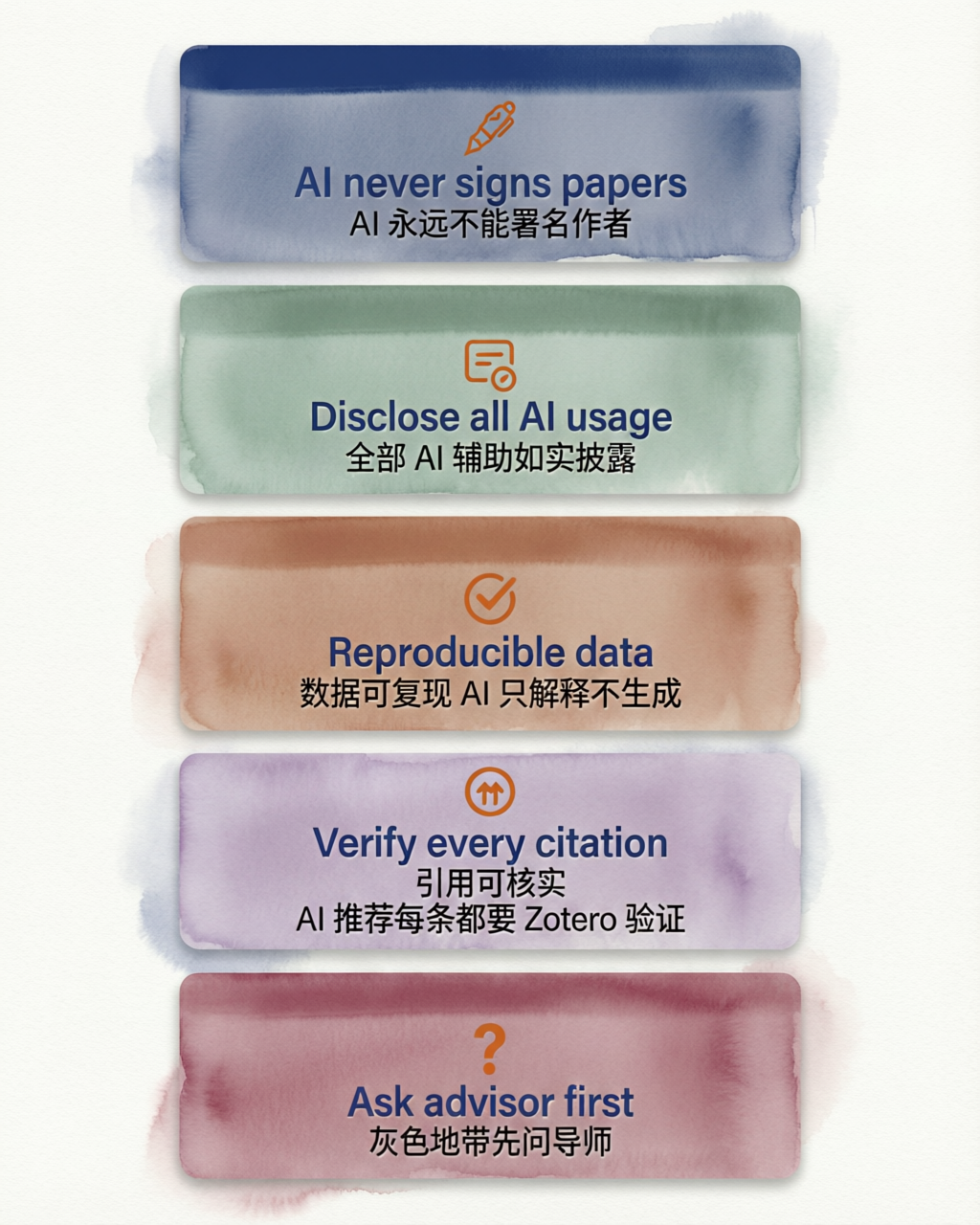
图 0.4 AI 时代的研究者守则五卡——从「不署名」到「问导师」五条不可妥协底线。
🛠 AI 辅助研究栏|S0.0 读前震慑
七种剽窃(教育部 40 号令第 27 条):
剽窃、抄袭、侵占他人学术成果
篡改他人研究成果
伪造科研数据、资料、文献、注释
由他人代写、为他人代写论文或成果
未参加研究却在成果上署名
未经他人许可不当使用他人署名
其他严重违反学术道德的行为
五类 AI 新型不端:
AI 署名:将 AI 工具列为论文作者(违反 ICMJE 四条标准)。
AI 代写:全文或核心章节由 AI 生成且未声明。
AI 虚构:使用 AI 编造的文献、数据或访谈内容。
AI 隐匿:大量使用 AI 辅助,却在声明中刻意缩小范围。
AI 绕过:用 AI 改写他人文字,以规避查重检测。
《中华人民共和国学位法》第 37 条第(一)项:学位论文或者实践成果被认定为存在代写、剽窃、伪造等学术不端行为的,经学位评定委员会决议,学位授予单位不授予学位或者撤销学位。教育部解读明确将 AI 代写纳入「代写」范畴。
这就是翟天临案、「毕业十年撤销学位」案的法律依据。请记住:学位不是终点,是一个可以被追溯收回的承诺。
English Edition
Chapter 0 · Research Integrity: From Scientific Methodology to the Researcher’s Code in the AI Era
This chapter starts from the most basic question—“What is science?”—and unfolds layer by layer along “natural science → social science → economics → financial research,” arguing for the scientific status of economics as a social science. Using Wallace (1971)’s Wheel of Science as its backbone, it marks out the boundaries of research integrity in the age of AI. It does not teach a single line of code or run a single regression, but it will help you build the underlying logic for “judging what is permissible and what must never be done.”
Learning Objectives
After completing this chapter, you should be able to:
State the fundamental distinction between scientific research and traditional ways of knowing (experience, belief, authority).
Draw Wallace (1971)’s Wheel of Science and mark the “enhancement points” and “risk points” of AI at each stage.
Identify the seven forms of plagiarism defined by Ministry of Education Decree No. 40 and the five new types of misconduct added in the AI era.
Recite the handbook’s five ultimate recommendations and name the normative document each one corresponds to.
0.1 Why Research Must Begin with Integrity
Many students are “educated” about “academic integrity” repeatedly in their first year of graduate school and think it is old news. But the integrity opening of this handbook differs from the usual orientation lecture—we do not start from “moral preaching” but from “the internal requirements of scientific methodology.” Section 0.2 first makes clear the foundational question “Is economics a science?” and only then returns to integrity itself—so that “research must be honest” is not merely a slogan but a hard constraint that scientific methodology imposes on the researcher.
The costs of integrity are not abstract. The three real cases below involve a top-tier journal, a doctoral degree, and a university administrator—after reading them you will see that integrity is not a slogan but a hard constraint that will one day determine whether you can earn your degree or keep your job.
Case 1 Top-Journal Retraction: “Storyteller Geng” Debunks a Nature Sub-journal Paper (2026)
Event: In April–May 2026, the science-communication blogger “Storyteller Geng” publicly questioned a paper published in a Nature sub-journal for image and data issues. The video spread rapidly across the internet. Xinhua News Agency followed up with an in-depth investigative report (2026.5.26), and CNR ran a piece titled “Why did this alarm the whole internet” (2026.5.27).
Consequence: The paper in question entered the journal’s investigation and retraction process; the academic reputations of the authors were seriously damaged; and the research-integrity management of their home institution was pushed to the center of public scrutiny.
Lesson: A top-journal halo is not a “free-pass medal.” In the era of open science and internet-wide re-examination, any single image or dataset may be re-inspected by countless eyes. Data and images must be real, traceable, and reproducible—this is something AI cannot “patch” for you, nor should you let AI “patch” it.
Case 2 Degree Revocation: The Zhai Tianlin Case (2019)
Event: In February 2019, actor Zhai Tianlin, when asked about his thesis in a livestream, responded “What is CNKI?” The remark triggered public scrutiny of his academic credentials. Subsequent checks found extensive plagiarism in his published papers, and the Beijing Film Academy issued a notice on 2019.2.19 (reported by People’s Daily Online).
Consequence: The Beijing Film Academy revoked his doctoral degree, and Peking University’s Guanghua School of Management revoked his postdoctoral qualification. A doctoral cap that had been worn for years was taken back.
Lesson: Academic misconduct does not “expire.” With the implementation of the Degree Law, academic misconduct in a degree thesis can be pursued for life.
Case 3 Removal from Office: Plagiarism by a School Party Secretary at a Southwestern University (2026)
Event: In August–September 2026, media disclosed that the 150,000-character monograph of a school Party Secretary at CD University contained large-scale plagiarism, and two of his English papers were found to contain fabricated citations. On 2026.9.1 the university announced the formation of an investigation team (reported by Guancha.cn and Xinhua News Agency).
Consequence: On 2026.9.30 the university issued a disciplinary notice: the expert investigation team confirmed academic misconduct; he was removed from the post of school Party Secretary, stripped of his senior professional title qualification, disqualified from research-project applications, professional-title evaluations, and awards for 36 months, with the case entered into the database of serious research-integrity violations; the university’s discipline inspection group opened a case for review (Xinhua News Agency, 2026.9.30).
Lesson: Before integrity there is no high or low office. Whether you are an ordinary student or a cadre in a management position, once academic misconduct is verified, the standard of handling is the same—from removal from office and revocation of titles to a permanent record in the integrity-violation database, the cost runs through the entire career.
These three cases share one feature: none of them is a failure of “insufficient ability”; each is the result of a single breach at some link of the research process—an image in a paper that was not verified, a citation that was not checked, authorship that was not truthful, a data source that could not be explained. And the research process is exactly what this handbook will walk you through, link by link.
Figure 0.1 The integrity balance—academic assets set against three warning labels.
0.2 From Science to Economics: The Hierarchy and Lineage of Research Methodology
Before discussing integrity, we must answer a foundational question: Is economics a science? This section builds the argument along the hierarchy “natural science → social science → economics → financial research.” Comrade Xi Jinping, in his “Speech at the Symposium on Philosophy and Social Sciences”[80], stated explicitly: “A country without developed natural sciences cannot stand at the forefront of the world, and a country without flourishing philosophy and social sciences cannot stand at the forefront of the world either.” This positioning means that the scientific status of philosophy and social sciences, including economics, is a question that must be answered head-on, not evaded.
Where Does Scientific Knowledge Come From
“Science” is defined as “the organized, systematized knowledge contained in fields that employ the scientific method.” It differs from the other ways we acquire knowledge in daily life:
Empirical intuition: “I have been investing for twenty years; by feel, housing prices in the south of Chengdu will keep rising”—it may be right, but you cannot tell others how you arrived at this conclusion.
Authoritative assertion: “Some expert says it will rise”—you cannot independently verify it, and if the expert is wrong, no one is held accountable.
Belief and faith: Cannot be observed or falsified; falls outside the domain of science.
Scientific knowledge, by contrast, is “a body of laws and theories, obtained through the scientific method, used to explain phenomena or behavior.” It stands on two pillars: logic (theory) and evidence (observation), which depend on each other—neither is dispensable.
Three Characteristics of Scientific Knowledge
Falsifiability: A theory must be advanced in a form that “can be refuted.” A claim that is always right no matter what, and can never be falsified, is not science.
Replicability: Others can independently redo the work with the same method and obtain the same or similar results. This is precisely why “code + data reproducibility” is emphasized in economic and financial research.
Self-correction (parsimony + post-positivism): Science does not pursue absolute truth in one stroke; it spirals upward from “worse theories → better theories,” using the most parsimonious explanations (Occam’s razor) to keep approaching reality.
Preview: The three research purposes—“explore / describe / explain”—will be operationalized into concrete research designs in Chapter 4.
Social Science: The Science of “People” and “Society”
Social science is the family of disciplines that take social phenomena as their object and “people and their social behavior” as their research subject—economics, sociology, political science, law, education, management, and the like all belong here. Its difference from natural science lies mainly in the complexity of the research object, not in any fundamental methodological divide:
Disciplinary character: The research object is “human behavior and its social structure,” different from the “natural phenomena” of natural science. But the research methodology shares the same pillars—the dual verification of logic (theory) + evidence (observation).
The Marxist-philosophical height: Chen Yulu, “Accelerating the Construction of Philosophy and Social Sciences with Chinese Characteristics,” Qiushi 2024(3)[81], states explicitly: “The Marxist principles on the materiality of the world and its laws of development, on human society and its laws of development, and on the nature of cognition and its laws of development provide us with the basic worldview and methodology for studying and grasping every discipline and field of philosophy and social sciences.” This is an authoritative endorsement, from the height of Marxist philosophy, of the scientific status of the social sciences.
Autonomous knowledge system: During his 2022 inspection at Renmin University of China, Comrade Xi Jinping emphasized: “Accelerating the construction of philosophy and social sciences with Chinese characteristics ultimately comes down to constructing China’s autonomous knowledge system”[82]. This is the strategic goal set at the top level for work in philosophy and social sciences, and it is the policy backdrop for the methods main line of this handbook.
The Scientific Status of Economics as a Social Science
Economics is the core branch of the social sciences, and its scientific status can be argued on three grounds:
Logic (theory) pillar: Starting from the assumption of scarcity, economics deduces testable propositions—fully consistent with the “theory → hypothesis” path of Wallace (1971)’s Wheel of Science. The deductive chain runs unbroken from Adam Smith’s “invisible hand,” through Marshall’s partial-equilibrium analysis, to modern general-equilibrium theory (Arrow–Debreu).
Evidence (observation) pillar: From Smith’s observation of the division of labor in The Wealth of Nations, through Keynes’s empirical study of effective demand in The General Theory of Employment, Interest and Money, to modern finance’s asset-pricing models and macroeconometric identification strategies—all rely on empirical data for repeated revision and verification.
Self-correction: From the Marginalist Revolution (1870s), the Keynesian Revolution (1930s), and the Neoclassical Synthesis (1950s) to the rise of behavioral finance (1980s–), these paradigm shifts are precisely the spiral ascent from “worse theories → better theories”—the closed loop of “empirical generalization → theory revision” on the Wheel of Science.
Thus, although economics takes “people” as its research object, it fully retains all the information components (theory / hypothesis / observation / empirical generalization) required by Wallace (1971)’s Wheel of Science.
Financial Research: A Typical Application Scenario of the Wheel
Finance, the most active applied branch of economics, is the best vantage point for watching the Wheel of Science turn. Take a concrete cycle of financial research:
Example: Start from “information asymmetry theory” → deduce the testable hypothesis “the broader the coverage of credit reporting, the lower the default rate of farmer loans” → design fieldwork or micro-database tests → induce empirical regularities → revise or extend the theory of “farmer credit reporting in the digital-finance era.”
This complete cycle maps exactly onto the six components of the Wheel: theory (information asymmetry) → hypothesis (testable proposition) → observation (data collection) → empirical generalization (statistical regularity) → theory revision (model extension) → back to theory (a new cycle). The chapters that follow (Chapters 4–10) will take each of these steps apart for you.
Core conclusion of this section: As the core branch of the social sciences, economics follows the same dual pillars of “logic + evidence” as the natural sciences. Wallace (1971)’s Wheel of Science is not merely a flowchart for sociological research; it applies equally to economics and financial research. Section 0.3 now opens up this wheel.
0.3 Wallace’s Wheel of Science + the AI-Enhanced Research Wheel
Section 0.2 has argued the scientific status of economics as a social science. This section opens up the “Wheel of Science” (The Wheel of Science) drawn by sociologist Walter Wallace (1971)[1]—the hidden backbone of this handbook. Complementing it is the classic formulation of “what research is” in Booth et al., The Craft of Research[83]: research is asking a question worth asking and answering it with evidence others can verify. First the parts and the operation of the wheel; then how AI embeds into each cell.
The Wheel of Science: Figure 1 of Wallace’s Original Book
📐 结构图示(书版示意图的文字要点)
- tikzpicture
- ->,thick,NavyBlue
- Theory
- Hypothesis
- Observation
- Logical deduction
Figure 0.2 Wallace’s Wheel of Science (redrawn from Figure 1 of Wallace 1971). Rectangles = information components (theory / hypothesis / observation / empirical generalization); ellipse = methodological control; solid arrows = information transformation; dashed arrows = the hypothesis-testing loop.
The Wheel in Operation: From Deduction to Induction
When research is actually done, the Wheel turns in six steps (clockwise):
Theory: Start from an existing theory (e.g., “information asymmetry theory”).
Deduction → hypothesis: Derive a specific testable hypothesis from the theory (e.g., “the broader the coverage of credit reporting, the lower the default rate of farmer loans”).
Observation: Design the study and collect data to test the hypothesis (questionnaires, databases, fieldwork).
Induction → empirical generalization: Induce empirical regularities from the observed data (e.g., “the data show the two are indeed negatively correlated”).
Revise the theory: Use the empirical generalization to verify, revise, or extend the existing theory.
Back to theory: The wheel closes and enters the next spiral ascent.
This is precisely the confluence on one wheel of the two paths—induction (observation → theory) and deduction (theory → observation). It is a “spiral ascent,” not a simple loop—with every turn, the theory should come closer to reality.
The AI-Enhanced Research Wheel: The “Three-Tier Classification” for Each Stage
More than fifty years after the Wheel was born, AI is reshaping every stage. Grossmann et al.[2] and Bail[3] point out, from the policy and the practical ends respectively, that LLMs rely on the “shadow” of human experience in their training corpora rather than on experience itself, and carry systemic risks such as bias amplification, unreproducible black boxes, and the flood of low-quality “junk science” (details in Section 0.4).
📐 结构图示(书版示意图的文字要点)
- tikzpicture
- ->,thick,NavyBlue
- Theory
- Hypothesis
- Observation
- Data Analysis
- 0,1,...,5
- OliveGreen
Figure 0.3 The AI-Enhanced Research Wheel: the Wheel of Science expanded into six stages (theory → hypothesis → observation → data analysis → empirical generalization → theory revision), with the AI tool layer embedded at the center; node colors follow Table 0.1’s “AI three-tier classification”: green = permitted, yellow = must-disclose.
Now place AI into this wheel. The handbook colors every stage with the “AI three-tier classification” that runs through the whole book (i.e., the node coloring of Figure 0.3):
• ✅ Permitted: AI does instrumental, accelerating work and does not change the primacy of human academic judgment.
• △ Must-disclose: AI participated in substantive content production and must be truthfully disclosed in an “AI Use Statement.”
• ❌ Forbidden: Touches the bottom line of integrity; must never be done under any circumstances.
Table 0.1 The AI three-tier classification: “Permitted / Must-disclose / Forbidden” across the stages of the Wheel of Science.
L5|L5|L5|L5|L5
Wheel stage & • ✅ Permitted (green) & • △ Must-disclose (yellow) & • ❌ Forbidden (red) & Chapter
Theory & Use AI to retrieve theoretical lineages and map concept genealogies; leverage AI to mine cross-domain knowledge-graph links to discover new research questions[79] & AI-assisted drafting of the theory-review first draft & AI directly “invents” a theory and passes it off as your original contribution & Ch. 2 / Ch. 3
Hypothesis & Use AI to list candidate hypothesis directions; Grossmann[2] notes LLMs can capture diverse theoretical perspectives and generate plural hypotheses; use high-performance computing and AI for high-risk, exploratory cross-disciplinary research[79] & AI-assisted derivation of the hypothesis’s logical chain & Using AI after the fact to “fit” hypotheses to significant results & Ch. 4 S4.1
Observation (data) & AI-assisted data collection/scraping (web crawlers, API calls, PDF/scan parsing); AI-assisted data cleaning, format conversion, missing-value flagging; use AI for large-scale data cleaning and preprocessing to speed up research[79] & AI-generated coding schemes / cleaning code (must be reviewed); Bail[3]: LLM text-coding consistency is about 95%, close to trained human coders & AI fabricating data, inventing samples, forging questionnaires and interviews; discriminatory coding of marginalized groups; (note: AI scraping of real, existing data ≠ fabricated data, but must comply with robots.txt, site ToS, and the Personal Information Protection Law) & Ch. 6–7 S6.1
Empirical generalization (analysis) & AI for statistical computation, output interpretation, diagnostic advice; explore new “human–machine collaborative research” models, focusing on the irreplaceability of humans in theory innovation, problem posing, and ethical judgment[79] & AI-assisted writing of econometric code (you must run and verify it yourself) & AI fabricating regression results / coefficients /
Theory revision (writing) & AI for language polishing, structure review, removing AI-sounding prose & AI-assisted reviews and first drafts (scope must be disclosed) & AI listed as an author; full-text AI ghostwriting concealed; Bail[3] warns of the flood of low-quality “junk science” & Ch. 11 S11.1\
0.4 Six Principles of Research Ethics + Domestic and International Norms
The Wallace Wheel tells you “how to do research correctly”; research ethics tells you “how to do research legitimately.” Research ethics can be boiled down to six core principles—the first four are the classic bottom lines, the last two are new in the AI era—mapped against the domestic and international normative documents you must know.
The Six Principles of Research Ethics in the AI Era
The four information components of the Wallace Wheel correspond to four classic research-ethics principles; after AI entered the full research workflow, the OECD[59], UNESCO[60], and ICMJE added two more bottom lines for AI use in research: “transparency” and “accountability.” The six principles and their AI-era implications follow.
Honesty. Report data, methods, and results truthfully; do not fabricate, falsify, or conceal unfavorable findings; negative results must also be disclosed.
AI-era implication. Bail[3] points out that AI models can generate “hallucinated” data and false statistical results; AI-assisted papers show artificially inflated effect sizes and suppressed
-values; Grossmann[2] lists this as the core risk behind the flood of low-quality research. Practical rule: any AI-generated numbers, tables, and regression results must be independently reproduced before they enter the main text. Objectivity. Let evidence, not stance, determine conclusions; keep bias or interest-driven distortion out of data collection, analysis, and interpretation. A negative exemplar: Merck concealed the fatal side effects of “Vioxx,” ultimately causing thousands of deaths and paying USD 4.85 billion in damages.
AI-era implication. Grossmann[2] reports that socio-cultural biases in LLM training data get amplified, producing discriminatory coding against women and ethnic minorities; Bail[3] finds empirically that GPT-series models respond with systematic bias to the elderly, widows, Mormons, and other groups, which may distort research conclusions. Addendum: web data scraped with AI assistance also carries sample-coverage bias (e.g., scraped Weibo comments skew toward active users; scraped job-board data skews toward high-exposure positions), and the scraping scope, time window, and representativeness limits must be reported in the “data-source statement.” Practical rule: when AI is used for coding or classification, bias-test results must be reported.
Respect for Intellectual Property. Do not plagiarize or appropriate the work of others; cite properly; mark sources when using others’ data and unpublished work.
AI-era implication. Authorship attribution for AI-assisted reviews and drafts has no consensus yet; Grossmann[2] notes the copyright dispute over LLM training corpora is still unfolding, and the model’s “black-box” character makes it hard to verify underlying data sources. Practical rule: when using AI for writing, the statement must name the tool, its version, and the scope of use, and the authenticity of every cited source must be verified.
Social Responsibility. Research must be accountable to its subjects and to society—informed consent, anonymity and confidentiality, doing no harm to participants, and results that serve the public interest.
AI-era implication. Bail[3] reminds us that the environmental cost (carbon emissions) of LLM training and inference cannot be ignored; Grossmann[2] stresses that simulating human subjects with AI raises new privacy issues, and algorithmic fairness (access equity) should enter research-ethics review. Practical rule: for data on sensitive groups, AI cannot substitute for the informed-consent procedure.
Transparency and Explainability. The research process and tool choices should be reviewable by readers; key decision nodes should be traceable. Both the OECD[59] AI Principles and the UNESCO[60] Recommendation on the Ethics of AI list this as a bottom line.
AI-era implication. ICMJE requires authors to declare at submission whether AI was used, specifying the tool, version, and stage of use; Grossmann[2] points out that the “black-box” nature of LLMs is a significant obstacle to the credibility of AI-assisted research. Practical rule: papers that use AI should contain a standalone “AI Use Statement” subsection (see Chapter 11 S11.1).
Accountability. The researcher bears final responsibility for the entire content of the paper, including the parts produced with AI assistance.
AI-era implication. OECD[59] explicitly requires that the actor behind an AI system be responsible for its behavior; the fourth of ICMJE’s four authorship criteria—“agreement to be accountable for all aspects of the work”—is one AI cannot satisfy, so AI cannot be listed as an author. Practical rule: if AI generates a wrong regression coefficient, it is your paper that gets retracted.
Unethical ≠ necessarily illegal. Many behaviors sit in the gray zone between ethics and law: the law may not punish them, but they can get you ostracized in your professional field, damage your reputation, or even cost you your job for dereliction of duty. What to do in the gray zone? Remember recommendation No. 5 of this handbook—ask your supervisor first.
Six Principles × Domestic and International Norms Table
Each of the six principles has a core normative document at the domestic and international levels:
Table 0.2 Six principles × domestic norms.
L3|L3|L3
Principle & Core domestic document & Key points
Honesty & MOE Decree No. 40, Measures for Preventing and Handling Academic Misconduct in Institutions of Higher Education[4] & Article 27 lists seven forms of academic misconduct
Objectivity & MOST, Guidelines for Responsible Research Conduct (2023)[5] & Norms for data collection, analysis, and reporting
Respect for IP & Ministry of Education/Ministry of Science and Technology, Implementation Rules for Handling Academic Misconduct in Higher Education (2024) & Plagiarism determination and improper-authorship handling
Social responsibility & Sichuan Agricultural University Party Document [2024] No. 127, Measures for Graduate Academic Ethics and Conduct & University-level academic-ethics requirements and sanction standards
Transparency & explainability & MOE, Guidelines for Teachers’ Use of Generative AI (First Edition) & Boundaries of AI use and disclosure requirements
Accountability & MOE Decree No. 40 + 2024 Implementation Rules & Responsibility attribution and sanctions for AI-assisted output
— & Degree Law (effective 2025)[61] & Article 37(1): theses involving “ghostwriting, plagiarism, falsification” and other misconduct → degree withheld or revoked; MOE interpretation places AI ghostwriting within “ghostwriting”
— & Renmin University Journal AI Statement (2025)[62] & CSSCI benchmark. Four prohibitions: (1) no AI-generated core viewpoints/conclusions; (2) no AI rewriting-splicing to evade detection; (3) no concealment of AI use; (4) no AI-fabricated data or references. Disclosure duty: use in non-core stages requires a statement—tool name + version + provider, time + stage + purpose, original prompts + generation records, and how it appears in the paper\
Table 0.3 Principles / core international documents / key points quick reference.
L3|L3|L3
Principle & International document & Key points
Honesty & ICMJE Recommendations (2023 revision) & AI must not be listed as an author; AI-generated content must be checked for hallucination
Objectivity & Grossmann et al. 2023[2] / Bail 2024[3] & Training-data bias → discriminatory coding → distorted conclusions
Respect for IP & ICMJE + publisher AI policies & Copyright attribution of AI-assisted text and citation-verification duties
Social responsibility & UNESCO Recommendation on the Ethics of AI[60] & Human rights, fairness, environmental sustainability, inclusive development
Transparency & explainability & OECD AI Principles[59] & AI systems transparent, explainable, auditable
Accountability & OECD[59] + ICMJE & Actors responsible for AI-system behavior; AI fails the fourth authorship criterion\
In the domestic table, the first six rows are the normative documents corresponding to the “six principles,” and rows seven and eight are the legal and journal-specific documents added in the AI era. In the international table, the OECD[59] and UNESCO[60] instruments are intergovernmental frameworks, ICMJE is the industry standard of academic publishing, and Grossmann[2] and Bail[3] are consensus-setting papers in the academic community. As a graduate student of Sichuan Agricultural University, University Party Document No. 127 concerns you most directly—it sets this university’s sanction standards; be sure to read the original text in your first semester.
In addition, other universities and local governments have issued their own detailed rules: Tsinghua (2025-11), Fudan (2024-11), and the School of Life Sciences of South China Normal University (2026-01) have all issued dedicated AI-use regulations; in September 2026 Beijing released the Beijing Guidelines for AI Applications in Education[79] with a “1+5+2” architecture. The table below organizes the higher-education “AI-assisted research” lists from those guidelines:
Table 0.4 List type / higher-education “AI-assisted research” requirements quick reference.
| List type | Higher-education “AI-assisted research” requirements |
| Prohibited | Core original thesis chapters (research design, data analysis, theory building, etc.) must not be substantively generated or proposed by AI; experimental or survey data must not be fabricated or falsified; content containing false information, academic fraud, or IP infringement must not be generated, and AI-generated fake citations must not enter the scholarly literature; AI must not perform peer review, thesis evaluation, project review, or other scholarly assessment duties requiring independent professional judgment |
| Limited use | AI may be used in a limited way for routine work such as literature retrieval, data processing, and language polishing; universities should establish a “trace-of-thinking” system that includes AI-use declarations and human-work traces in academic norms, requiring truthful disclosure of the stages, tools, and degree of AI use in coursework, theses, and research outputs, and should maintain a dynamically adjusted “campus AI tool usage guide” specifying the permitted tools, conditions of use, and verification requirements for each scenario |
| Encouraged | Encouraged: using high-performance computing and AI for high-risk, exploratory cross-disciplinary research; exploring new “human–machine collaborative research” models that focus on the irreplaceable role of humans in theory innovation, problem posing, and ethical judgment; mining cross-domain knowledge-graph links to discover new research questions and co-creating with machines in complex-system design; using AI for large-scale data cleaning and preprocessing to speed up research |
[Note] This table is organized from the appendix “Classified Application Guidance Lists” of the Beijing Guidelines for AI Applications in Education (2026), higher-education portion, “AI-assisted research” items (original pages 27–28 “Prohibited List,” pages 31–32 “Limited-Use List,” pages 34–35 “Encouraged List”)[79]. The core principle: problem definition, core argumentation, and academic judgment must be done by the researcher in person; AI is positioned as an “accelerator,” not a “substitute”—assisting with routine work such as literature retrieval and data processing, but not intervening in originality-critical stages such as research design and theory building.
[Tip] How to use this: you are not meant to memorize this table but to know which document to look up when a concrete question arises. For example, “Does citing this way count as plagiarism?” → check the 2024 Implementation Rules; “I used AI for my literature review—do I have to say so?” → check the MOE AI Application Guidelines + Chapter 11 of this handbook; “Can I list the AI as an author?” → check the ICMJE authorship criteria + Chapter 0 §0.5.
0.5 Five Ultimate Recommendations: The Researcher’s Code for the AI Era
Everything above is compressed into five recommendations; write them on the first page of your research notebook. They run through the whole handbook, and we will return to them at every stage.
Recommendation 1: AI Must Never Be Listed as an Author
Under the ICMJE (International Committee of Medical Journal Editors) four authorship criteria, an author must simultaneously: (1) have made a substantive intellectual contribution to the research; (2) have participated in drafting the paper or revising it critically; (3) have approved the final version; and (4) have agreed to be accountable for all aspects of the work, ensuring its accuracy and integrity.
AI cannot satisfy item (4)—it cannot be responsible for results, cannot be held accountable, and cannot testify in court. Therefore no AI tool may be listed as an author. Putting ChatGPT in the author list is the most typical, and the most foolish, form of misconduct in the AI era.
Recommendation 2: All AI Assistance Must Be Truthfully Disclosed in a Use Statement
If you used it, say so; and when you say it, say it in full. This handbook requires you to write one statement at each of three nodes (see Chapter 11 for details):
Proposal version: preview which AI tools you plan to use and for which stages.
Submission version: following the target journal’s requirements, list truthfully the actual scope of AI use.
Defense version: explain to the defense committee the specific contribution boundary of AI in the thesis.
“Deliberately understating the scope of AI use” is itself misconduct.
Recommendation 3: Data and Results Must Be Reproducible—AI Explains, It Never Generates Numbers
✅ Your data must come from real, traceable channels (databases, questionnaires, fieldwork).
✅ Your numbers (means, coefficients, standard errors,
-values) must be produced by code that you yourself run. ✅ AI may help you interpret these numbers and write the code to compute them.
❌ AI must never “generate” a single number that enters your paper.
The test: for every number in your paper, you must be able to re-run it in front of anyone. A number you cannot re-run must not stay in the paper—not one.
Recommendation 4: Citations Must Be Verifiable—Verify Every Reference AI Recommends
AI (especially large language models) will “invent references with a straight face”—author, journal, year, and DOI all look plausible, but the paper simply does not exist.
Strategy: every reference recommended by AI must be verified one by one before you decide whether to cite it (see Chapter 3 S3.2). Copying AI-suggested references without verification is like burying your own mine—one click of a link by a reviewer and your manuscript may be rejected.
Recommendation 5: In the Gray Zone, Ask Your Supervisor First, Then the School’s Academic Committee
Misconduct often sits in the gray zone between ethics and law. When you are unsure “whether this is really allowed,” the order of resolution is:
Ask your supervisor first—for most ambiguous questions, one sentence from your supervisor settles the boundary.
Then ask the school’s academic committee—for disputes at the institutional level, use the formal channel.
Never “gamble on it yourself.” The cost of integrity problems is asymmetric: asking costs almost nothing; guessing wrong can cost a degree and a career.
[Key point] End-of-semester review: these five recommendations plus the handbook’s 23 S.X.Y checkpoints have been distilled into Appendix D, “Ten Integrity Self-Check Questions.”.
Figure 0.4 The five cards of the researcher’s code in the AI era—five non-negotiable bottom lines, from “no AI authorship” to “ask your supervisor.”
🛠 AI-Assisted Research|S0.0 A Sobering Read Before You Begin
Seven forms of plagiarism (MOE Decree No. 40, Article 27):
Plagiarizing, copying, or appropriating the academic achievements of others
Falsifying the research achievements of others
Fabricating research data, materials, references, or annotations
Having others ghostwrite, or ghostwriting for others, papers or achievements
Being named on achievements without having participated in the research
Improperly using another person’s name without permission
Other serious violations of academic ethics
Five new types of AI misconduct:
AI authorship: listing an AI tool as a paper author (violates the four ICMJE criteria).
AI ghostwriting: full text or core chapters generated by AI without disclosure.
AI fabrication: using AI-invented references, data, or interview content.
AI concealment: heavy use of AI assistance while deliberately understating it in the statement.
AI laundering: using AI to rewrite others’ text to evade plagiarism detection.
Article 37(1) of the Degree Law of the People’s Republic of China: where a degree thesis or practical achievement is found to involve ghostwriting, plagiarism, falsification, or other academic misconduct, upon resolution of the degree-evaluation committee the degree-granting institution shall withhold or revoke the degree. The MOE interpretation explicitly places AI ghostwriting within the scope of “ghostwriting.”
This is the legal basis of the Zhai Tianlin case and the “degree revoked ten years after graduation” case. Remember: a degree is not an endpoint; it is a promise that can be traced back and taken away.