📖 《把 AI 当助手——经济实证研究的诚信、方法与工具》双语网页版:每章中文部在前,English Edition 在后,内容与最新合订 PDF 一致。
第3章 · 文献回顾与选题
本章导览
学习目标
完成本章后,你应当能够:
说出文献回顾三目的(知识现状 / 关键作者文章理论 / 知识缺口),并能在自己的综述里指出对应的三个部分
独立完成 Zotero 全流程五大动作:入库 → 组织 → 补全文 → 引用 → 导出
用“概念矩阵”(conceptual matrix)组织 30 篇文献,并从空白格与矛盾处读出研究缺口
用精读五要素(问题 / 理论 / 方法 / 发现 / 贡献与局限)拆解一篇本方向经典论文
说出候选题目的四个来源通道(现实观察 / 文献缺口 / 学术对话 / 方法迁移),并能把一个真实现象转化为候选题目
用选题三问(gap / 数据可得性 / 能力圈)收敛出 1 个候选题目,产出
one_page_proposal.md
[提示] 本章是全手册“体力活”最集中的一章——约七成时间在读文献、建库、填矩阵。这种投入,决定你后面是在做研究还是在返工。
本章产出物(三件)
表 3.1 本章产出物(三件)。
L3|L3|L3
产出物 & 文件名 & 说明
文献库 & & ≥30 篇经核实的参考文献,由 Zotero 导出
概念矩阵 & & 30 行 × 5 列(样本 / 方法 / 核心发现 / 理论贡献 / 局限)
选题卡 & & 一页纸研究计划,八栏\
[重点] 三方向命名建议:农金方向 ;风险管理/保险方向 ;金融理论与政策方向 。
本章工具(先确认,再学习)
Zotero 10(主轴)+
cli-anything-zotero(命令行桥)三个 MCP:
nber-cli-mcp/scansci-pdf/zenodo-mcp两个 Skill:
arxiv/litreview
如果第 1 章你还没装齐,现在装也来得及——本章每一节都配了自检命令。
§3.1 文献回顾三目的与检索策略
检索策略:三步滚雪球
不要一上来就搜“数字普惠金融 农户收入”、按被引量排序、下载 50 篇——那样你会淹死在文献里,而且一定漏掉关键文章。正确顺序是:
第一步 · 从综述入手(先拿地图)
找 2-3 篇高质量的近期综述(review / survey / 研究进展 / 文献述评)。综述已经帮你把领域地图画好了。
中文:知网搜“数字普惠金融 研究进展”“农业保险 综述”,优先看《经济研究》《管理世界》《中国农村经济》《金融研究》上的综述文章
英文:Google Scholar 搜
review/literature review/survey;或直接翻 Journal of Economic Literature、Annual Review of Financial Economics
第二步 · 顺藤摸瓜(参考文献回溯 + 施引追踪)
拿到一篇好文章后,做两个方向的追踪:
往回看(backward):读它的参考文献表,找出被反复引用的 5-8 篇——这些是领域的“祖师爷”文章(服务目的 2)
往前看(forward):在 Google Scholar 点 “Cited by”,看谁引用了它——这些是最新进展(服务目的 1)
第三步 · 关键词扩展(补漏)
用前两步积累的术语扩展检索式。特别注意同义词、上下位词、中英对照:
表 3.2 检索策略:三步滚雪球。
L3|L3|L3
中文关键词 & 英文关键词 & 上位/相关概念
数字普惠金融 & digital financial inclusion & financial inclusion / fintech
农户信贷可得性 & rural credit access & credit rationing / financial exclusion
农业保险 & agricultural insurance / crop insurance & index insurance / weather derivatives
金融素养 & financial literacy & financial capability / financial knowledge
货币政策传导 & monetary policy transmission & credit channel / interest rate channel\
[提示] 文献回顾“不应局限于几种期刊上的文章、几年内的文章,或者运用特定的研究方法的文章”。新手最常见的偏食是——只读实证回归的文章,不读理论模型和案例研究,结果综述视角单一。
经济研究的特殊性:中英文双轨检索
这是本手册相对通用方法论著作必须补上的一条。做中国金融问题研究:只查英文库会被审稿人一票否决;只查中文库则无法与国际对话。
表 3.3 经济研究的特殊性:中英文双轨检索。
L3|L3|L3
轨道 & 主要来源 & 你必须从中拿到什么
英文轨(SSCI) & NBER 工作论文、JF / RFS / JBF、Journal of Development Economics、World Development、Agricultural Economics & 理论框架、识别策略、国际前沿与最新分歧
中文轨(CSSCI) & 知网 / 万方 / 维普(学校 VPN)、《经济研究》《管理世界》《金融研究》《中国农村经济》《数量经济技术经济研究》 & 中国制度背景、政策演进时点、本土理论对话\
双轨的具体分工:
用英文文献确定理论与方法(例如金融排斥理论、DID 识别策略、工具变量选择)
用中文文献确定制度背景与政策时点——例如“数字乡村发展战略”“三大粮食作物完全成本保险试点”具体哪年、在哪些县推开。这是做 DID 的命脉,时点搞错整篇论文作废
综述里两轨都要出现,并说明国内研究相对国际研究推进了什么、还差什么——这正是第 2 章 §2.6“国内研究脉络意识”的落地
[重点] 关于知网:本手册不集成 CNKI 自动化工具(合规考虑)。中文文献请通过学校图书馆 VPN 手动检索,再导入 Zotero。一句话流程:知网检索 → 导出 Refworks/NoteExpress 格式 → Zotero 导入 → 逐条手动核对题录。
§3.2 检索源矩阵 5 件套
第 1 章你已经装好了 MCP / Skill / CLI 三类工具。这一节告诉你做文献回顾时该用哪几个。下面五个是本手册主线的“检索源矩阵”:
表 3.4 检索源矩阵 5 件套。
L5|L5|L5|L5|L5
工具 & 类型 & 覆盖范围 & 适用场景 & 调用方式nber-cli-mcp & MCP & NBER 工作论文(经济/金融顶刊的预印本池) & 前沿追踪、找最新工作论文 & search_papers / get_paper_info / download_paperscansci-pdf & MCP & 已发表论文全文 PDF(多源路由) & 拿到题录后补全文 & scansci_pdf_``search / scansci_pdf_``resolve_and_``download / scansci_pdf_``zotero_pushzenodo-mcp & MCP & 开放数据集 + 预印本 + 复现代码 & 找可复现数据、找别人的复现包 & search_records / get_metadata / get_citation / list_filesarxiv & Skill & arXiv(量化金融 q-fin、经济物理、机器学习方法) & 方法论文预印本 & /arxivlitreview & Skill & Consensus 学术搜索引擎 + PICO/SPIDER 检索框架 & 快速搭建综述骨架 & /litreview\
各工具实操要点
① nber-cli-mcp——追前沿
NBER 工作论文是美国经济金融学界“预出版”的主渠道,JF / QJE / AER 上的文章很多先在 NBER 挂出。适合你在开题阶段问:“这个题目国际上最近两年谁在做?做到哪一步了?”
search_papers:按关键词搜索,支持日期过滤(例如只要 2024 年之后的)与分页get_paper_info:先看摘要和作者,判断值不值得下载download_paper:下载 PDF 到本地论文库
② scansci-pdf——补全文
你手里有一串 DOI 但打不开(付费墙)时的第一选择。它的特点是多源路由:依次尝试多个来源直到拿到 PDF。
△ 实测提示:单条下载比批量下载稳定。批量接口的参数包装有陷阱,新手容易反复失败
➤ 独门能力:
scansci_pdf_zotero_push可把下载到的 PDF 直接推进 Zotero 对应条目,省去手动拖拽
③ zenodo-mcp——找数据
Zenodo 是 CERN 运营的开放仓库,大量经济学/农经论文的复现数据与代码存放在这里。
什么时候用:你想做可复现研究;或者想找一个别人已清洗好的数据集练手(对接第 6 章“数据来源全景”)
get_citation直接给出规范引用格式——用了别人的数据集就必须引用,这是数据伦理,也是 S6.1 的留痕要求
④ arxiv——找方法
量化金融方向(资产定价、高频交易、机器学习预测)必读 arXiv 的 q-fin 分区。
- △ arXiv 上的文章大多未经同行评审,引用时必须标 “working paper” 或 “preprint”,不能当已发表论文引
⑤ litreview——快速搭骨架
基于 Consensus 引擎(用 AI 从真实论文中抽取结论)+ PICO/SPIDER 检索框架,产出一份 Word 格式的“研究指南”。
它的自我定位是“发射台”(launching pad):让你快速对一个陌生领域建立信心,不是成品综述
正确用法:跑一遍 → 拿到候选文献清单 → 逐条用 Zotero 核实(S3.1)→ 再去读原文
中文文献怎么办
上面五件套几乎不覆盖中文 CSSCI 文献。中文轨请走:
知网(CNKI)/ 万方 / 维普:通过学校图书馆 VPN 访问
国家哲学社会科学文献中心(ncpssd.org):部分期刊提供全文
各期刊官网:《经济研究》《管理世界》等有自己的网站
流程:中文库手动检索 → 导出题录(Refworks / NoteExpress / EndNote 格式)→ Zotero 导入 → 逐条核对(作者、年份、刊名、期号、起止页码)。
△ 手动导入的中文题录错误率很高,尤其是刊名缩写、期号、页码。参考文献里写“《金融研究》2021 年第 3 期”而实际是第 5 期,是最容易被审稿人抓住的低级错误。导入后请对照知网页面逐条核。
关键认知:每种工具都有盲区
表 3.5 关键认知:每种工具都有盲区。
L2|L2
工具 & 盲区nber-cli-mcp & 只有 NBER;不含欧洲/亚洲工作论文;完全不含中文scansci-pdf & Wiley / OUP / Emerald / SSRN 等绕不过(见 §3.4 黑名单)zenodo-mcp & 以数据集与复现包为主,期刊论文覆盖有限arxiv & 几乎没有传统金融/农经的实证文章litreview & 依赖 Consensus 索引,中文文献极少\
结论:任何单一检索源都不足以支撑一次合格的文献回顾。交叉使用是原则——至少覆盖四类来源:英文工作论文 + 英文已发表论文 + 中文 CSSCI + 数据仓库。
[提示] 本机全部 13 个学术 MCP + 45 个学术 Skill 的清单见附录 E;工具盘点的原始实测记录见
handbook_assets/references/本机学术工具盘点_2026-09-21.md。
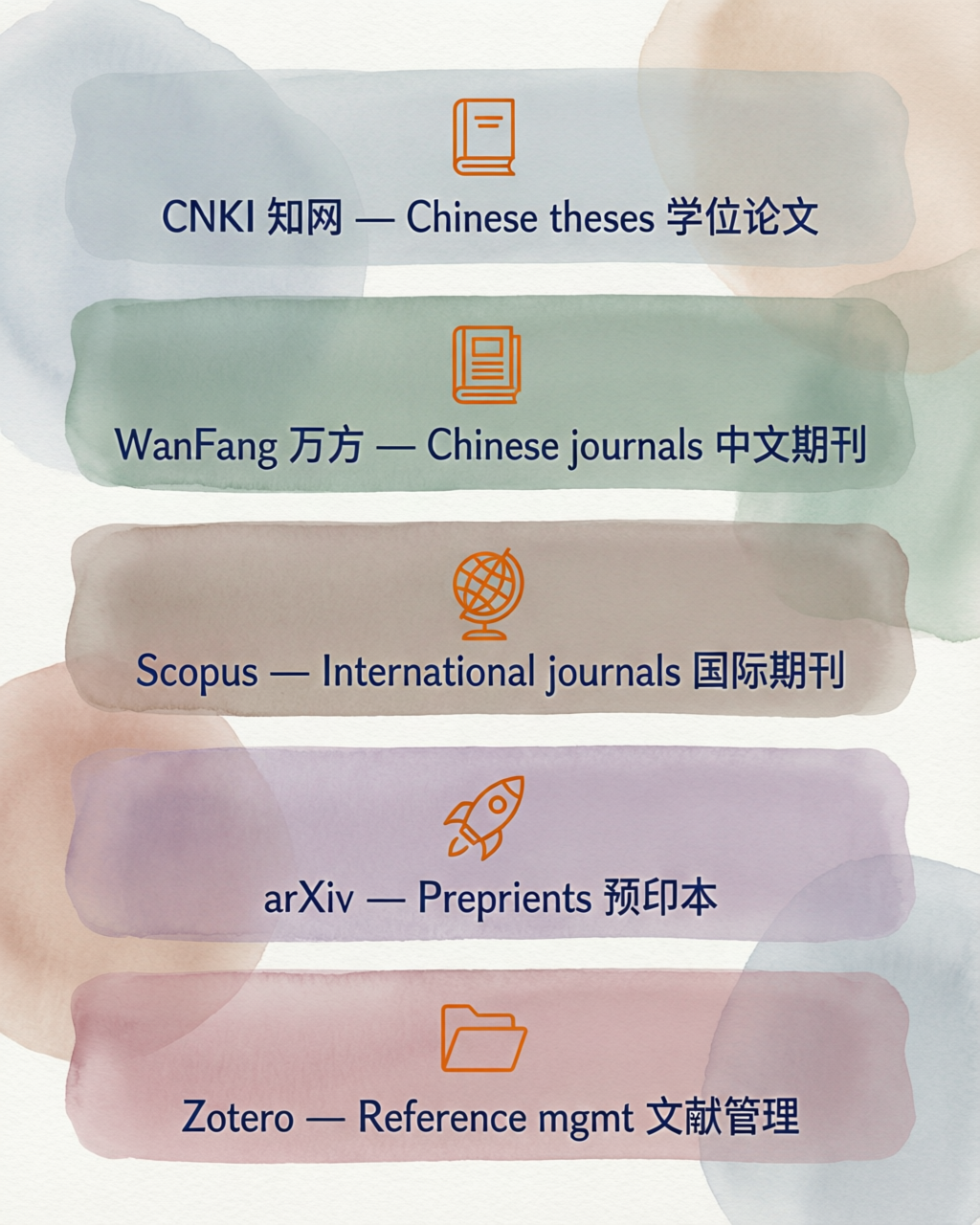
图 3.1 文献检索源五件套全景——知网、万方、Scopus、arXiv、Zotero 各有所长,交叉使用是原则。
§3.3 Zotero 10 环境与全流程
Zotero 是本手册的主轴文献工具——从第 3 章建库,到第 11 章论文写作插引用,全程用它。不用 Zotero 也能做研究,但你会在参考文献格式上白白耗掉几十个小时。
环境确认(教师机实测)
表 3.6 环境确认(教师机实测)。
L3|L3|L3
组件 & 版本 / 路径 & 作用
Zotero 桌面端 & 10.0.1,/Applications/Zotero.app,数据目录 ~/Zotero & 主程序
& & 命令行桥(AI 可调用)
CLI Bridge 插件 & & 让命令行与桌面端通信
Better BibTeX & 插件 & 引用键(citekey)管理、.bib 导出
jasminum(茉莉花) & 插件 & 中文文献元数据抓取
zotero-pdf-translate & 插件 & PDF 划词翻译
better-notes & 插件 & 双链笔记\
三条自检命令:
cli-anything-zotero app doctor      # 环境自检
cli-anything-zotero app status      # 连接状态
cli-anything-zotero item list       # 能否读到库内条目
三条都有正常输出,说明“桌面端 + 命令行桥”通了。如果 item list 报连接错误,先确认 Zotero 桌面端正在运行——CLI 桥依赖桌面端进程。
五大动作
Zotero 的使用可以压缩成五个动作。请按顺序完整练一遍。
动作 1 · 入库(把文献变成 Zotero 条目)
表 3.7 五大动作。
L3|L3|L3
方式 & 命令 / 操作 & 说明
DOI 自动抓取 & & 最推荐:元数据准确, 顺手抓全文
arXiv 编号 & cli-anything-zotero add arxiv 2301.12345 --fetch-pdf & 量化金融方向常用
BibTeX 批量 & cli-anything-zotero add bibtex myrefs.bib & 导入别人给的 .bib(如课程讲义的 merged_all_references.bib)
URL & cli-anything-zotero add url https://... & 网页、政策文件、统计公报
PDF 拖入 & 直接把 PDF 拖进 Zotero 窗口 & 拖入后右键 →“重新抓取 PDF 元数据”
手动录入 & 工具栏“新建条目” & 无 DOI 的中文老文献、内部资料\
[提示]
add doi ... --fetch-pdf这一条命令做了两件事:① 通过 DOI 解析抓取完整题录元数据;② 尝试自动下载开放获取的 PDF。这就是本手册推荐的“入库标准动作”。
动作 2 · 组织(让 300 篇文献还找得到)
Collection(分类)= 按项目分:
硕士论文/、课程作业-农村金融/、投稿-农业保险/。一篇文献可同时属于多个 CollectionTag(标签)= 按主题分:
#数字普惠金融、#DID、#待精读、#已引用。标签跨项目复用,是检索主力笔记:每条文献下挂一条笔记,写三件事——这篇为什么重要 / 核心结论一句话 / 我能用它的哪部分。不写笔记的文献等于没读
cli-anything-zotero collection create --name "硕士论文"
cli-anything-zotero collection list
cli-anything-zotero item tag --key ABCD1234 --add "待精读"
cli-anything-zotero note add --key ABCD1234 --body "核心结论:数字金融通过缓解信贷约束提高农户收入"
动作 3 · 补全文(有题录没 PDF = 半成品)
cli-anything-zotero item fetch-pdf --key ABCD1234              # 单条:OA 级联抓取
cli-anything-zotero collection fetch-pdfs --name "硕士论文"     # 整分类批量补
抓不到的走 §3.4 的五招。Better BibTeX 会同时自动补全缺失的元数据字段(卷、期、页码等)。
动作 4 · 引用(写作时插入引文)
表 3.8 场景 / 做法速查表。
L2|L2
场景 & 做法
Word & Zotero Word 插件 → Add/Edit Citation → 选条目 → 自动按目标期刊格式排版
LaTeX & Better BibTeX 自动维护 .bib,正文用 \cite{citekey}
Markdown / Quarto & 用 citekey:@smith2020;渲染时 pandoc --citeproc --bibliography=refs.bib
命令行取引用 & cli-anything-zotero item citation --key ABCD1234
生成国标参考文献 & cli-anything-zotero item bibliography --key ABCD1234 --style "GB/T 7714"
Word 引用管线 & cli-anything-zotero docx cite(把 {{zotero:ITEMKEY}} 占位符替换为真实引用字段)\
动作 5 · 导出(交付给导师 / 期刊 / 合作者)
# 导出整个分类为 BibTeX(供 LaTeX / Quarto)
cli-anything-zotero export bib --collection "硕士论文" \
    --format bibtex --output rural_finance_30papers.bib

# 导出指定条目
cli-anything-zotero export bib --items ABCD1234,EFGH5678 \
    --format biblatex --output subset.bib
桌面端等价操作:选中条目 → 右键 → 导出条目 → 选 BibTeX(供 LaTeX)或 RIS(供其他文献软件)。
三个进阶命令(省时间神器)
表 3.9 三个进阶命令(省时间神器)。
L3|L3|L3
命令 & 作用 & 什么时候用item semantic-search --query "..." & 本地语义搜索(不联网、免费) & “我库里有没有讲信贷配给的文章?”——比关键词搜索准得多item search-fulltext --query "..." & PDF 全文检索 & 想找“哪篇文章里提到过某个具体政策文件名”item duplicates + item merge & 查重与合并 & 库超过 200 条后必做,否则同一篇文章存在三个版本\
本章练习(跟做)
新建 Collection
文献回顾练习用 DOI 方式入库 3 篇英文文献(带
--fetch-pdf),用手动方式入库 1 篇中文文献给 4 篇都打标签
#待精读,每篇写一条两句话笔记跑一次
item semantic-search --query "digital finance rural income",看能否命中导出为
.bib,用文本编辑器打开,逐条检查字段是否完整(作者/年份/刊名/卷期页码/DOI)
[重点] 完成后你的库里应有 4 条带 PDF、带笔记、带标签的条目。这就是后面 30 篇的雏形。
§3.4 PDF 获取避坑 5 招
“找不到全文”是研究生最常见的挫败感来源。好消息:绝大多数学术论文都能合法拿到。坏消息:方法不对的话,你会白白浪费一整天。
五招(按优先级顺序试)
招 1 · 学校 VPN / WebVPN 优先
最合法、最稳定、成功率最高。学校图书馆订购了知网、万方、维普、Elsevier(ScienceDirect)、Springer、Wiley、Taylor & Francis、EBSCO 等主流数据库。
校内 IP 直接访问;校外走 WebVPN
△ WebVPN 会改写 URL(加编码前缀)。从 WebVPN 页面复制出来的链接不能直接分享,也别粘给自动化工具——它会失效
找不到的库:走图书馆“文献传递”服务(CALIS / 国家科技图书文献中心 NSTL),一般 1-3 个工作日到手
招 2 · scansci-pdf MCP 搜索(多源路由)
scansci_pdf_search                 --title "Digital finance and rural income"
scansci_pdf_resolve_and_download   --doi 10.1016/j.jdeveco.2020.102471
scansci_pdf_zotero_push            --doi 10.1016/j.jdeveco.2020.102471   # 直接推进 Zotero
多源路由的意思是:它会依次尝试多个来源直到拿到 PDF。实测单条比批量稳定(批量接口的参数包装有陷阱)。
招 3 · 作者主页 / ResearchGate 直接索取
很多教授把全部论文挂在自己主页(尤其美国高校)。Google 搜
"论文完整标题" filetype:pdf常能直接命中ResearchGate 有 “Request full-text” 按钮,作者通常一周内会发给你
直接发邮件给作者索取是学术界完全正常、甚至被鼓励的行为。邮件三句话即可:自我介绍 → 说明你为什么对他的文章感兴趣 → 请求 PDF。这比你想的容易得多,而且经常能开启一段学术联系
招 4 · Google Scholar “All versions”
在 Google Scholar 搜索结果右侧找 [PDF] 标记,或点标题进详情页看 “All versions”。里面常有:机构知识库版、作者自存档版、PMC 版。
补充一招——用 OpenAlex API 查所有开放副本位置:
curl -s "https://api.openalex.org/works/doi:10.1016/j.jdeveco.2020.102471" \
  | jq '.locations[] | {landing_page_url, is_oa, pdf_url}'
招 5 · NBER / SSRN / RePEc 工作论文版
期刊正式版常要付费,但工作论文版通常免费且内容九成一致。
NBER:
https://www.nber.org/system/files/working_papers/{编号}/{编号}.pdf(curl可直下,成功率极高)SSRN:需注册登录,但下载免费
RePEc / IDEAS:经济学工作论文总索引
△ 引用规范:如果你读的是工作论文版,引用时要么标 “NBER Working Paper No. xxxxx”,要么去核对正式版有无实质修改(版本年份、期刊、卷期页码都不同)。绝不能读了工作论文版却引用正式版的页码——页码对不上属于引用不实(关联 S3.2)。
绕不过的黑名单(别浪费时间)
以下出版社反爬强度高,自动化工具基本失败,只能走机构 WebVPN 或图书馆:
表 3.10 绕不过的黑名单(别浪费时间)。
L2|L2
出版社 & 拦截方式
Wiley & Cloudflare 挑战
Oxford University Press & Cookie 挑战
Emerald & JS 挑战
Preprints.org & Akamai
SSRN & SSL 拒绝 + 登录墙\
下载后必做:两步验证
反爬网站常返回一个几 KB 的 HTML 页面,文件名却叫 .pdf。看起来下载成功了,打开是乱码或空白。
第一步 · 文件类型验证:
head -c 4 论文.pdf
# [v] 必须返回:%PDF
# [x] 返回 <!DO 或 <htm -> 这是 HTML 假文件,下载失败

ls -lh 论文.pdf
# 正常学术论文一般 300KB - 5MB;小于 20KB 高度可疑
第二步 · 内容一致性验证:打开 PDF 首页,核对三件事是否与 Zotero 条目一致:
标题一致(注意副标题、版本号)
作者一致(拼写、顺序、通讯作者)
年份与期刊一致(会议版 vs 期刊版最容易混)
为什么要这么较真?因为参考文献错配是最隐蔽的学术不端。你以为引的是 A 文章,实际下载的是 B 文章(同名、同作者不同年、会议版 vs 期刊版),写综述时把 B 的结论挂在 A 名下——这正是 S3.1 要防的事。
安全与合规提醒
❌ 不从来路不明的“论文下载站”“免费文献网”下载——这类站点常捆绑恶意软件、勒索程序,或返回被篡改的 PDF
❌ 不使用“上传一篇才能下载一篇”的互惠分享站(这本身侵犯版权,而你上传的可能是导师的未发表稿件)
✅ 合法路径优先级:机构订阅 → 开放获取(OA)→ 作者自存档 → 直接向作者索取
§3.5 概念矩阵综述法
什么是概念矩阵
一张表,两条规则:
行 = 文献(每篇论文一行)
列 = 核心构念 / 比较维度(每篇都填同一组格子)
列的选择取决于你的研究目的。通用五列:
表 3.11 什么是概念矩阵。
L3|L3|L3
列 & 填什么 & 为什么要这一列
样本 & 谁、多少、哪年、哪个地区 & 判断结论能否推广到你的情境(外部效度,回指第 4 章 §4.2)
方法 & OLS / FE / IV / DID / PSM / RDD / 案例 / 仿真 & 判断该领域的“方法水位”,你要不要跟上
核心发现 & 一句话结论 + 关键系数或效应量 & 综述的实质内容
理论贡献 & 这篇推进了什么理论或视角 & 找到你要对话的对象(服务目的 2)
局限 & 作者自己承认的 + 你看出来的 & 缺口就藏在这里(服务目的 3)\
示例矩阵(农村金融方向,5 篇 × 5 列)
△ 下表为教学示例,文献信息为演示格式,请勿直接引用。你要做的是用自己核实过的真实文献填一张同样结构的表。
表 3.12 示例矩阵(农村金融方向,5 篇 × 5 列)。
L7|L7|L7|L7|L7|L7|L7
# & 文献 & 样本 & 方法 & 核心发现 & 理论贡献 & 局限
1 & 作者甲(2022)《金融研究》 & 2011—2020 年中国 31 省面板 & 双向固定效应 + 中介效应 & 数字普惠金融显著缩小城乡收入差距,信贷渠道贡献最大 & 把金融排斥理论扩展到数字场景 & 省级数据掩盖省内差异
2 & 作者乙、作者丙(2023)《中国农村经济》 & 2019 年 5 省 1200 户农户调查 & Probit + IV(同村平均使用率) & 数字金融使用提高农户正规信贷可得性 8.3 个百分点 & 引入“数字足迹”作为信息不对称的替代机制 & 截面数据难以识别因果
3 & 作者丁(2021)《经济研究》 & 数字普惠金融指数 + 县域数据 & DID(试点政策) & 试点县创业活跃度上升 12% & 政策评估视角 & 试点选择非随机,平行趋势存疑
4 & Smith & Lee (2023) World Development & 印度 3 邦农户面板 & RCT & 移动支付推广改善消费平滑,但对收入无显著影响 & 区分“平滑”与“增收”两类效应 & 单一国家情境
5 & Zhang (2024) Agricultural Economics & 中国家庭金融调查 CHFS & FE + PSM & 数字金融对低收入组边际效应更大 & 异质性视角 & 未考虑数字素养门槛\
从这张表你能立刻读出三个 gap(空白格与矛盾处):
样本 gap:5 篇里 3 篇是省级或县级宏观数据,缺少农户层面的长期追踪面板——你能不能做一个 3 年追踪?
方法 gap:只有 1 篇用了 RCT,唯一的 DID 平行趋势存疑——更干净的识别策略(工具变量、断点)是空间
情境 gap:国际证据(印度)显示“平滑有效、增收无效”,中国证据几乎都说“增收有效”——这个分歧本身就是选题(为什么中国不一样?)
[提示] 这就是概念矩阵的威力:gap 不是你“想”出来的,是从表格的空白格和矛盾处“读”出来的。流水账综述做不到这一点,因为它的信息是线性的、不可比的。
与流水账综述的对照
表 3.13 与流水账综述的对照。
L3|L3|L3
维度 & 流水账综述 & 概念矩阵
组织方式 & 按时间,或“张三说…李四说…” & 按维度(列)横向对比
可比性 & 差——每段结构不同,无法比较 & 强——同一列直接对齐
缺口识别 & 靠作者主观断言“研究尚不足” & 从空白格 / 矛盾处客观读出
写作难度 & 低(易上手,也易注水) & 中(要先想清楚比较维度)
审稿人评价 & “文献堆砌,缺乏述评” & “梳理清晰,缺口有说服力”\
重要提醒:概念矩阵是你的工作工具,不是论文里的最终形态。论文中的文献综述仍然是连贯段落,但段落的组织逻辑来自矩阵的列——例如按“方法演进”或“结论分歧”分段,而不是按作者姓氏笔画。
AI 辅助填表流程(S3.1 必守)
Step 1(AI)  把 30 篇的摘要/PDF 分批喂给 AI,让它按五列抽取
Step 2(人工)逐格核对——尤其是“核心发现”里的数字和“方法”一栏
Step 3(人工)补上 AI 抽不出来的东西——理论贡献的判断、你自己看出的局限
Step 4(人工)从填好的矩阵里找空白格与矛盾,写出 gap
为什么 Step 2 不能省:AI 抽取“核心发现”时最高频的三类错误是——① 把摘要里的背景句当成结论;② 数字或系数抄错、甚至凭空补一个;③ 把作者写的“未来研究方向”当成“已有发现”。这三类错误一旦进了你的综述,就构成 S3.1 定义的引用不实。
产出物
表 3.14 产出物。
L3|L3|L3
文件 & 内容 & 提交对象
& ≥30 篇经核实文献(Zotero 导出) & 导师concept_matrix.xlsx & 30 行 × 5 列概念矩阵 & 导师 / 自己开题用\
[重点] 方向不同,矩阵的“列”也应不同:
风险管理/保险方向:建议加一列“保险产品类型”(成本保险 / 完全成本保险 / 收入保险 / 指数保险)
金融理论与政策方向:建议加一列“理论流派”(货币主义 / 凯恩斯主义 / 新结构经济学 / 金融功能观)
农村金融方向:建议加一列“分析层级”(农户 / 村 / 县 / 省)
§3.6 论文精读五要素 + 综述写作
精读五要素
矩阵填的是“广度”,精读练的是“深度”。从 30 篇里挑 3-5 篇最核心的,用五要素拆一遍。拆完这 5 篇,你对这个领域的理解会超过大多数同级同学。
表 3.15 精读五要素。
L4|L4|L4|L4
# & 要素 & 你要回答的问题 & 拆不清的后果
1 & 研究问题 & 这篇到底在问什么?是 What / Why / How 哪一类?(回指第 2 章句式) & 你自己选题时会问出模糊的问题
2 & 理论框架 & 基于什么理论?核心构念有哪几个?构念之间什么关系? & 你的综述没有理论主线
3 & 方法设计 & 样本从哪来?变量怎么测?用什么识别策略?为什么它能解决内生性? & 你看不懂别人的表,也设计不出自己的
4 & 核心发现 & 主结论一句话 + 关键系数(方向、大小、显著性)+ 机制检验结果 & 你引用时会引错
5 & 贡献与局限 & 相对前人推进了什么?作者承认哪些不足?你还能看出哪些不足? & 你找不到 gap\
精读笔记模板(每篇一份,存为 Zotero 笔记或独立 md 文件):
# 精读笔记:{作者} {年份} {标题}

## 1 研究问题
- 原文表述(引一句话,标页码):
- 类型:[ ]What [ ]Why [ ]How
- 我的复述(不抄原文):

## 2 理论框架
- 核心理论(如信息不对称、交易成本、制度理论等):
- 关键构念(列出 3-5 个):
- 构念间关系(画因果箭头或写命题):
- 理论框架图(截图或手绘拍照):

## 3 方法设计
- 数据来源(一手/二手?抽样方式?样本量?):
- 因变量:____ 测量方式:____
- 自变量:____ 测量方式:____
- 控制变量(至少列前 5 个):
- 计量模型(写出回归方程或识别策略名称):
- 内生性处理(IV / DiD / RDD / 稳健性检验):

## 4 核心发现
- 主结论(一句话概括):
- 关键系数(方向 + 大小 + 显著性水平):
- 机制检验结果:
- 异质性分析(哪些子样本效应更强/更弱?):

## 5 贡献与局限
- 对文献的推进(相对前人多了什么?):
- 作者承认的局限(引原文页码):
- 我看出的局限:
- 对我研究的启发(可直接用 / 可批判 / 可扩展):
[提示] 与第 10 章的关系:这里练的是实证型论文的精读。第 10 章还会讲案例型论文的精读法(Eisenhardt 八步)与理论型论文的精读法(例如 Diamond-Dybvig 1983 银行挤兑模型),三者互补。
综述写作三件套
有了矩阵和精读笔记,综述怎么落成文字?三种组织方式,可以混用。
① 主题式组织(最常用)
按矩阵的“列”或按理论分支分段,而不是按作者。
2.1 数字普惠金融的测度(谁测过、怎么测、有什么分歧)
2.2 数字金融与农户收入:证据与分歧
2.3 作用机制研究:信贷渠道 / 信息渠道 / 创业渠道
2.4 述评与研究缺口
② 时间线梳理(适合方法或政策演进明显的领域)
第一阶段(2010 年前):金融排斥理论奠基
第二阶段(2011—2016):普惠金融政策化,测度体系建立
第三阶段(2017 至今):因果识别精细化,从“相关”走向 DID / IV
③ 方法论对比(适合实证方法争议大的领域)
按“用什么方法 → 得出什么结论 → 方法差异能否解释结论分歧”来组织。这是最容易写出深度的方式,也最能体现你的方法素养。
AI 腔自检
综述是最容易被 AI 腔污染的地方。以下是必须删掉或改写的表达:
表 3.16 AI 腔自检。
L3|L3|L3
❌ AI 腔 / 空话 & 问题在哪 & ✅ 改法
“XX 学者深入探讨了……” & “深入”是你的评价还是空话? & “XX(2022)用 DID 估计了……,系数为 0.12”
“具有重要的理论和现实意义” & 每篇都重要 = 没有一篇重要 & 说清对谁重要、在哪个环节重要
“国内外学者对此进行了大量研究” & 大量是多少?谁? & “国内至少 12 篇 CSSCI 论文(2020—2024)……;国际方面……”
“取得了丰富的研究成果” & 零信息量 & 直接说结论分歧在哪
“综上所述,已有研究仍存在不足” & 不足在哪必须具体 & “已有研究存在三点不足:① 样本多为省级……② 识别策略……③ ……”
“为本文的研究提供了有益的借鉴” & 套话 & “本文在 XX 的基础上,把样本下沉到农户层面”\
判别口诀:一句话里如果没有具体的作者、年份、方法、数字或结论,它就是空话——删掉或改写。
[重点] 第 11 章会系统讲学术风格与 AI 披露。这里先记住一条:综述的每一句话都应该能被追溯到概念矩阵里的某一格。
§3.7 选题三问 → one_page_proposal.md
文献读完了,矩阵填好了,现在要收敛。但在收敛之前,先回答一个更根本的问题:候选题目从哪里来?30 篇文献能生出 20 个候选题目,你只能做 1 个——先有候选池,再谈筛选。
选题的由来:候选题目从哪里来
候选题目不是凭空冒出来的,它有四个来源通道。好的选题往往同时踩中两到三个通道:一个现实中的真现象(通道一),恰好文献里没说清(通道二),而且是你有数据与方法够得着的(这正是后面三问要替你把的关)。
表 3.17 选题的由来:候选题目从哪里来。
L4|L5|L5|L5
通道 & 特征 & 去哪里找 & 例子
① 现实观察 & 田野、新闻、政策文件里的反常或困惑 & 寒暑假返乡观察、央媒财经报道、中央一号文件、地方政策试点 & 手机支付普及多年,为何农户贷款难依旧?政策性农业保险为何“推而不广”?
② 文献缺口 & 概念矩阵的空白格与矛盾处(§3.5) & 你自己填好的概念矩阵;综述文章的“未来研究方向”节 & 矩阵里“数字金融 × 储蓄行为”整列空白;两派结论在南方与北方相反
③ 学术对话 & 前沿工作论文正在争论什么 & NBER/知网工作论文、顶刊近三年论文的引言与结论、学术会议题目 & 微观数据可得性骤变后,旧结论的识别策略被重新审视
④ 方法迁移 & 别的学科早有现成方法,你所在领域没人知道它存在;难点在计算或复现,不在概念与制度 & 问一句“别的学科遇到这种计算是怎么处理的”(AI 跨学科检索擅长此题,但须回源学科文献核实);开源计算工具链是现成方法池,哈佛物理学家 Schwartz 的 BootLoops 把贝叶斯证据积分从粒子物理搬到系统发育即示范[84] & 水稻保险重现期估计,已实做迁移洪水统计 POT 法\
从现象到候选题目的转化公式:观察到的现象 + 一个“为什么 / 如何 / 什么影响”的提问 = 候选题目。注意方向:选题的起点是现象与困惑,文献(通道二)负责告诉你这个困惑是否已被解决——而不是反过来先找文献再硬编一个现象。
经济学界关于选题来源的经典论述:田国强[68]在《经济研究》中指出经济学研究由“界定问题域→建立参照系→确定基准点→发展分析工具→进行经验检验”五部分组成,界定问题域是第一步且不可由后四步替代;林毅夫[69]强调研究者应保持“常无”心态——不带预设地进入现象,问题意识来自真实世界的困惑而非文献中的技术空白;聂辉华[71]在《经济学家茶座》的经典随笔中直言“研究的问题比技术更重要”;姚洋[70]在同一主题演讲中指出,经济学研究应从直面真实世界、理解制度约束出发,而非从技术先进性出发反向找题目。**本土实证见:**张亚光、毕悦[75]对《经济研究》创刊至 2022 年的引文计量分析表明,国内经济学选题的热点前沿正从单一的政策热点驱动,向“数据可得性扩展+方法创新+理论对话”三轮驱动演变——这与本手册的“三问”框架高度契合。[72][73]
△ 诚信提醒:不要为“好发文章”追逐热点硬造题目。选题的由来将在开题报告与答辩中被反复追问——“你为什么研究这个?”答案必须能追溯到真实的观察、真实的文献缺口、真实的政策需求,或你自己跨学科检索并核实过的真实方法错位(通道四),而不是“AI 推荐的”或“师兄做过的”。
△ AI 工具诚信提醒:选题阶段 AI 的“隐性 gap-spotting 偏见”。当学生使用 AI 文献综述工具(如 ChatGPT、Consensus、Elicit 等)自动扫描文献并“寻找空白”时,工具输出的“尚未被研究的问题”在结构上几乎必然偏向 gap-spotting——因为这类工具的设计逻辑就是“找出 X 领域还没人做过的变量组合”,而对“现有文献的隐含前提是否错了”这类问题化思考则无能为力。洪永淼、汪寿阳[72]在《管理世界》中明确指出,大数据与机器学习“不能进行批判性思考”;同作者后续在《中国科学院院刊》中进一步强调,“人工智能不能替代理论创新”[73]。这与 Sandberg & Alvesson[74]发现的零篇问题化论文相互印证:AI 工具将本已主流的 gap-spotting 思维进一步固化,使真正的问题化选题更难出现。本手册建议:将 AI 工具作为通道二(文献缺口扫描)的加速器,但最终的选题判断——特别是“文献的隐含前提是否值得挑战”——必须由研究者自己完成。选题的原始灵感应来自通道一(现实观察)或通道三(学术对话中对既有假设的质疑),AI 只能辅助确认与放大,不能替代问题化的思维过程。[72][73]唯一的例外是通道四(方法迁移):模型读过所有学科,恰恰擅长提示“这个计算难点在别的学科已有现成解法”,这是 AI 在选题阶段少数真正的增量用处;但被提示后有两个硬义务,一是回到源学科文献核实该方法确实存在且适用,二是回答该题值不值得问——方法错位只保证能做出来,不保证有趣。这一条正是 Schwartz 所谓“Claude 形状的问题”:方法的搬运可以交给机器,研究品味的把关必须留给人[84]。
候选池生成后,用三问收敛:
问 1 · Gap:文献中什么没被研究?
来源:概念矩阵的空白格与矛盾处(见 §3.5)。三种典型 gap:
表 3.18 问 1 · Gap:文献中什么没被研究?。
L3|L3|L3
gap 类型 & 特征 & 例子
样本 / 情境 gap & 结论在一个情境成立,另一个情境没人验 & 数字金融的增收效应在印度不显著,那在中国西南山区呢?
方法 gap & 已有研究识别策略弱,你能做更干净的 & 前人用截面 Probit,你能做 DID(有明确政策时点)
机制 gap & 主效应已知,但“为什么”没打开 & 已知数字金融提高农户收入,但走的是信贷、创业还是汇款渠道?\
△ 不算 gap 的三种“伪 gap”:
“还没人研究过 A 县” —— 换个地名不是学术贡献
“数据更新到 2024 年” —— 延长时间不是贡献(除非期间发生了结构性变化,且你能说清是什么变化)
“国内还没有相关研究” —— 可能只是因为这个题目不重要,或者你搜得不够(先回去查知网)
gap-spotting 与 problematization 的区分。需要读者注意的是,上述三种 gap(样本/情境、方法、机制)都属于“文献里哪里没做,你去补上”的思维模式——Sandberg & Alvesson[74]将这种模式称为 gap-spotting(缺口填补),并指出它在当代管理学[76]与经济学顶刊论文中占据绝对主流(他们对 52 篇组织研究顶刊论文的编码分析发现,全部论文都采用 gap-spotting 方式定位贡献,零篇采用问题化)。与此相对,problematization(问题化)则意味着:不接受现有文献的隐含假设与理论前提,从对现实的困惑出发重新框定问题——这种选题风险更高,但理论贡献潜力也最大。国内管理学界已有对这一范式的系统引介:井润田、罗肖依、孙黎[76]基于 Sandberg & Alvesson 的框架,提出了四条具体的“问题化”路径;罗肖依、孙黎[77]则从理论构建方法论角度,进一步厘清了 gap-spotting 误区在国内管理学研究中的表现。对本手册读者的建议:在选题初期,先用 gap-spotting 思维(上述三种 gap)快速筛查候选题目是否成立;在确定候选题目后,再问自己一个“问题化”问题——“现有文献对这一现象的隐含前提是什么?如果这个前提错了呢?”——这正是田国强[68]所说“界定问题域”和林毅夫[69]所说“常无”心态的内核。
案例来源:孟加拉国留学生 Argha Mandal 的课程论文《Credit Access and Agricultural Productivity in Bangladesh: The Mediating Role of Technology Adoption》,使用 BIHS 面板数据(2011—2019),方法为结构方程模型(SEM)。
一、CARS 模型:前言写作的三语步结构
学术论文前言的功能是“开辟研究空间”(Create A Research Space, CARS),由 Swales (1990) 提出。每个前言段落都可以映射到以下三个语步:
| 语步 | 功能 | 典型中文表述 |
| M1 确立领域 | 告诉读者"这个话题很重要" | "近年来……受到广泛关注" |
| M2 建立研究空间 | 指出现有文献的不足/缺口 | "然而,已有研究较少关注……" |
| M3 占据空间 | 提出本文要填补的缺口 | "本文旨在……" |
M2 就是 gap-spotting 的修辞形态——作者通过“指出缺口”来论证自己研究的必要性。
二、案例诊断:Argha 的前言逐段映射
| 段落 | 内容摘要 | CARS 语步 | 诊断 |
| P1 | 孟加拉国经济转型,农业 GDP 占 11.66% 但就业占 45.3%——“矛盾数据”开场 | M1 | 用数据对比制造张力 |
| P2 | 政府已降低农贷利率至 8%、要求银行配置 2% 贷款;但小农仍面临 28 亿美元信贷缺口 | M1→M2 | “尽管做了很多,但问题依然存在” |
| P3 | “本研究探讨一个根本问题:信贷获取与农业生产率是什么关系?”紧跟方法(SEM)和核心发现(94.5% 中介效应) | M3 | 问题和答案在同一段落给出 |
| P4 | 四条贡献用 Firstly / Secondly / Lastly 清单列出 | M3 补充 | 覆盖样本规模、方法创新、理论挑战、政策意义 |
| P5 | “本文其余部分结构如下……” | 路线图 | 标准六节概述 |
三、问题诊断:纯 gap-spotting 的典型症状
Argha 的前言结构完整,但选题类型为纯 gap-spotting。三个典型症状:
症状一:选题逻辑是“政策做了但缺口依然存在 → 我来填补这个缺口”,从未质疑既有理论框架的隐含假设。
症状二:四条贡献中有三条是增量式——样本大(5,097 户)、模型规范比较(6 种 SEM 规格)、政策建议(第八个五年计划)。只有“94.5% 中介比率挑战传统认知”触及了理论层面,但未展开。
症状三:核心发现——直接效应
四、问题化改写:从“发现”到“挑战”
农村金融文献长期隐含一个未经检验的假设:信贷通过直接资本效应(更多资金 → 更多投入 → 更高产量)提升生产率。然而,如果这一假设成立,信贷充裕的农户应该显著比信贷不足的农户产量更高——但 Argha 的数据并不支持这一预测。信贷的真正作用路径不是“直接给钱”,而是“间接解锁技术采纳”——94.5% 的信贷→生产率关系通过技术采纳传递,直接效应几乎为零。
改写后的前言新增段落(插入 P2 与 P3 之间):
农村金融文献长期隐含一个未经检验的假设:信贷通过直接资本效应提升农业生产率——即更多资金意味着更多农资投入和更高产量。这一假设构成了“扩大信贷覆盖面就能提高生产率”这一政策逻辑的理论基石。然而,如果直接资本效应是信贷发挥作用的主要路径,那么信贷充裕的农户应显著比信贷不足的农户产出更高。初步证据表明,这一预测在孟加拉国并不成立:信贷与生产率之间的关系几乎完全通过技术采纳这一间接路径传递,而直接资本效应微乎其微。这一发现挑战了农村金融政策的基本前提:信贷本身并非生产率增长的驱动力,它只是解锁技术采纳的必要条件。
改写后的贡献陈述第一条(替换现有 Firstly):
优化后的题目(二选一):
方案 A(挑战性断言):Credit Alone Does Not Boost Productivity: The Mediating Role of Technology Adoption in Bangladesh
方案 B(反思性框架):Rethinking the Credit–Productivity Link in Bangladesh: Technology Adoption as the Missing Pathway, Not Credit Itself
五、改写前后对比
| 维度 | 改写前(Gap-spotting) | 改写后(Problematization) |
| 选题逻辑 | “孟加拉国没人用 SEM 研究过信贷→生产率” | “信贷直接提升生产率这个前提可能错了” |
| 陈述方式 | “已有文献忽略了……” | “现有研究隐含了未经检验的假设……” |
| 贡献定位 | 增量式(样本大、模型比较) | 理论性(挑战隐含假设) |
| 审稿人印象 | “又一篇信贷-生产率的 SEM” | “这篇文章推翻了一个默认前提” |
| 题目信号 | 中性描述 | 挑战性断言或反思性框架 |
问 2 · 数据可得性:数据从哪来?你拿得到吗?
这是最容易让选题胎死腹中的一问,必须现在就查清楚,不要拖到第 6 章。
自查清单:
用什么数据?(公开数据库 / 问卷调查 / 访谈 / 机构内部数据)
如果是公开库:已经下载到手了吗?(不是“应该能下到”)
如果是问卷:需要多少样本?谁帮你联系调研点?预算够吗?(第 7 章详解)
如果是机构数据:你有授权吗?能公开发表吗?(涉密就别碰)
关键变量的测度在数据里存在吗?(例如你想研究“数字足迹”,但数据库里根本没这个字段)
[提示] 铁律:没有数据的选题不是选题,是幻想。第 6 章会给你完整的数据源全景图,但这一问现在就要有一个初步答案。
问 3 · 能力圈:你的方法论储备够吗?
需要的计量方法我学过吗?(对照第 9 章清单:OLS / FE / IV / DID / PSM / RDD / ABM)
如果没学过:一学期内补得上吗?有教材、课程、师兄师姐可问吗?
需要的软件我会用吗?(Stata / R / Python)
需要的数理基础够吗?(结构模型、DSGE、ABM 对数理功底要求更高)
△ 能力圈不是让你只做简单的——而是让你在开题时诚实评估成本。选一个需要现学 IV + RDD 的题目,意味着你的时间预算要翻倍。
三问交叉:候选题目评分表
表 3.19 三问交叉:候选题目评分表。
L6|L6|L6|L6|L6|L6
候选题目 & Gap 强度(1-5) & 数据可得性(1-5) & 能力圈匹配(1-5) & 总分 & 决定
题目 A & & & & &
题目 B & & & & &
题目 C & & & & &\
[重点] 总分最高的不一定选——但如果 gap 强度只有 2 分,即使数据和方法都完美,也难发表。gap 强度是一票否决项(低于 3 分建议换题)。
one_page_proposal.md 模板
把三问的结果压成一页纸。为什么只要一页?因为写不成一页,说明你还没想清楚。
# 一页纸研究计划(One-Page Proposal)

**姓名**:____ **方向**:[ ]农金 [ ]风险/保险 [ ]金融理论 **日期**:____
**版本**:v0.1(第 3 章产出) **下一步升级**:research_design.md(第 4 章)

## 1 标题(暂定)
(不超过 25 字,含核心变量与情境。
 [×] “数字金融研究”
 [√] “数字普惠金融对农户收入的影响——基于 XX 省三年面板的 DID 证据”)

## 2 研究问题(一句话)
(用 What / Why / How 句式,标注类型。必须能被数据检验。)

## 3 理论对话对象
- 国际:____(作者 年份。你要支持、反驳还是扩展谁的结论?)
- 国内:____(作者 年份。本土理论脉络是什么?)
- 对话内容:他们认为___,我认为___,因为___

## 4 研究缺口(来自概念矩阵)
- gap 类型:[ ]样本/情境 [ ]方法 [ ]机制
- 具体描述:已有研究___,但___尚未被检验
- 矩阵证据:(指出矩阵里哪个空白格 / 哪处矛盾支撑这个 gap)

## 5 数据来源(初步)
- 数据名称:____
- 是否已到手:[ ]是(路径___) [ ]否(获取计划___)
- 样本与时间跨度:____
- 关键变量可得性:X___ Y___ 控制变量___

## 6 方法路线(初步)
- 设计类型:[ ]真实验 [ ]准实验 [ ]非实验(事后追溯)(第 4 章 §4.3 详解)
- 识别策略:[ ]OLS [ ]FE [ ]IV [ ]DID [ ]PSM [ ]RDD [ ]案例 [ ]仿真
- 预判的主要效度威胁:____(第 4 章 §4.2 七大威胁里挑 1-2 条)

## 7 预期贡献(一句话)
(不要写“填补空白”“具有重要意义”。写成下面三种之一:
 本文把___的证据从___扩展到___;
 本文用___策略纠正了___可能存在的偏误;
 本文打开了___的机制黑箱。)

## 8 三问自查
- Gap 强度:__/5  数据可得性:__/5  能力圈:__/5
- 最大风险点(最可能让研究失败的一件事):____
- 备选方案(Plan B):____
产出物与迭代链条
表 3.20 产出物与迭代链条。
L3|L3|L3
阶段 & 文件 & 新增内容
第 2 章 & research_question.md & 现象 + 问题 + 构念(种子)
第 3 章(本章) & one_page_proposal.md & + gap + 数据 + 方法(八栏)
第 4 章 & research_design.md & 升级为五栏完整方案 + 假说 + 理论框架图
第 5—6 章 & 同上迭代 & 补测量方案、数据细节与版本留痕
第 9—10 章 & 同上迭代 & 补实证结果、修正结论\
[目标] 把这三个文件都放进 Git(第 1 章 §1.5 五目录结构里的
docs/)。每次修改留 commit message,三个月后你会感谢自己。
🛠 AI 辅助研究栏|用法一:AI 抽取式概念矩阵(30 篇 × 5 列)
场景:你有 30 篇 PDF,手动读完填矩阵要一周。AI 预填 + 人工核对可以压到一天。
提示词模板(分批喂,一次 5 篇,多了会糊):
为什么最后那条要求很关键:让 AI 主动标出不确定处,比让它假装确定安全得多。你会拿到一份“待核对清单”,核对效率大幅提升。
工作量对比:
表 3.21 方式 / 30 篇耗时 / 质量风险速查表。
L3|L3|L3
方式 & 30 篇耗时 & 质量风险
纯手动精读填表 & 约 5—7 天 & 低,但人会疲劳出错、后期偷懒
AI 预填 + 逐格人工核对 & 约 1 天 & 中——取决于你是否真的逐格核对
AI 预填直接用 & 约 2 小时 & ❌ 极高,等同引用不实(S3.1)\
用法二:litreview / systematic-literature-review 跟做
场景:你要进入一个完全陌生的领域(例如导师突然让你做“气候金融”),需要在两天内建立基本认知。
跟做步骤:
Step 1  跑 /litreview,输入你的研究问题
        -> 产出:PICO/SPIDER 检索式 + Consensus 检索结果 + 一份 Word 研究指南

Step 2  把它给的候选文献清单导出来,逐条用 Zotero 核实:
        cli-anything-zotero add doi {DOI} --fetch-pdf
        -> 加得进去的 = 真实存在
        -> 加不进去的 = 存疑,去 Google Scholar / 知网二次确认

Step 3  对核实通过的文献,跑用法一的 AI 抽取矩阵

Step 4  如需正式系统综述,跑 /systematic-literature-review
        -> 它走“多源检索 -> 去重 -> AI 评分 -> 选文 -> 专家写作”完整流程,输出 PDF + Word
△ 定位提醒:litreview 自己的说明写得很清楚——产出是“发射台”(launching pad),让你有信心 dive in,不是成品综述。直接把它交上去 = 学术不端(见第 11 章 AI 披露要求 S11.1)。
用法三:AI 辅助“这篇值不值得读”
场景:检索出 200 篇,你只有时间读 30 篇。
提示词模板:
然后:AI 排完序,你自己再过一遍前 10 篇。AI 会漏掉那些“摘要写得平淡但方法极有价值”的文章,也会高估那些“摘要漂亮但与你无关”的文章。
本章 AI 用法三条纪律
AI 只做抽取和排序,判断由你做——“这篇重不重要”“gap 在哪”是你的学术判断,不能让渡
AI 填的每一格都必须核对原文——尤其是数字、系数、年份、页码
AI 生成的文字不能直接进综述——它可以帮你搭骨架,血肉必须你自己写(第 11 章 AI 披露)
🛡 AI 诚信栏|S3.1 AI 推荐文献必核实
红线:AI 推荐的任何一篇文献,在你把它写进综述或参考文献之前,必须确认它真实存在,且内容与你写的一致。
为什么这条排在五类 AI 不端之首
AI 会“推荐”根本不存在的论文——这叫幻觉引用(hallucinated citation)。它编造的方式非常狡猾:真实作者 + 貌似合理的标题 + 存在的期刊 + 编造的年份卷期页码。乍看无懈可击。
后果分级:
表 3.22 本章 AI 用法三条纪律。
L2|L2
场景 & 后果
课程作业里出现 1 条虚构文献 & 该次作业零分
学位论文参考文献里出现虚构文献 & 按教育部 40 号令可认定为学术不端,情节严重可撤销学位
期刊论文里出现虚构文献 & 撤稿 + 学术声誉终结(近年国内外已有多起知名学者因此撤稿)\
而且被发现的概率远比你想象的高——审稿人和答辩委员抽查引用的成本极低,搜一下标题就行。
检查方法(每条文献三步)
Step 1 · 存在性核验
   ① 有 DOI -> cli-anything-zotero add doi {DOI}
              能抓到元数据 = 真实存在
   ② 无 DOI -> Google Scholar 搜完整标题(加英文引号做精确匹配)
              搜不到 -> 换关键词再搜一次(可能是标题记错)
   ③ 中文文献 -> 知网搜标题 + 作者
   ④ 以上都搜不到 -> 判定为虚构,删除

Step 2 · 元数据核验(存在 ≠ 信息对)
   逐字段对照出版社官网 / 知网页面:
   作者全名与顺序 · 年份 · 标题 · 期刊全称 · 卷 · 期 · 起止页码 · DOI
   [!] 最常见错误:会议版误当期刊版、预印本误当正式版、卷期页码张冠李戴

Step 3 · 内容核验(信息对 ≠ 你引对了)
   打开 PDF,找到你要引用它的那个论点:
   ① 原文确实这么说吗?(不是“你说得像”)
   ② 你引的数字 / 系数和原文一致吗?
   ③ 你引的是原文的观点,还是原文转述别人的观点?(后者见 S3.2)
提交前自查表(逐条打勾)
表 3.23 检查项 / 状态速查表。
L2|L2
检查项 & 状态
每条文献都通过 DOI 解析或知网检索确认存在 & ☐
每条文献的作者 / 年份 / 刊名 / 卷期页码都对照过官方页面 & ☐
每条被引用的观点都在原文中定位到了具体页码 & ☐
引用的数字 / 系数与原文完全一致(不是估算或失真四舍五入) & ☐
没有任何一条文献是“AI 说有但我没找到原文”的 & ☐
工作论文版与正式版的区别已注明 & ☐\
一票否决:上表任何一项打不了勾,就不要提交。参考文献出错属于“低级但致命”的错误——它会让审稿人怀疑你整篇文章的所有内容。
S3.2 不虚构二次文献
定义:二次文献(secondary citation)指“你在 A 文章里看到 A 引用了 B,于是你去引用 B”。
情形 1 · 假装读过 B
[x] 你在 A 里看到“Bhattacherjee(2012)指出内部效度有七大威胁”。
   你没读过原书,却在参考文献里直接列出 Bhattacherjee(2012),
正文写成“Bhattacherjee(2012)认为……”这是伪造阅读痕迹。正确做法有二:
去把 B 找来读——多数情况能做到(教材和经典论文都拿得到;本手册对标的 Bhattacherjee 专著就是免费开放全文)
实在拿不到,规范标注为转引:
Bhattacherjee(2012),转引自 张三(2020),且参考文献只列张三(2020)。具体格式看目标期刊要求,GB/T 7714 有明确规定
情形 2 · 让 AI 编造引述
[x] 你让 AI“帮我写一段文献综述,要有 5 条引用”。
   AI 产出:“Lusardi 和 Mitchell(2014)指出,金融素养每提高一个标准差,
            退休储蓄增加约 15%。“
这个 15% 是 AI 编的——原文可能没有这个数字,甚至结论方向都可能不对。防范三招:
永远不要让 AI “补引用”。需要引用时,你先给 AI 具体的文献和具体的原文段落,让它帮你组织语言;而不是让它自己去找文献
数字必须溯源。综述里出现的每一个百分比、系数、样本量,都要能指出出自哪篇文献第几页
“某某指出”式句型属高危。凡是写“XX(年份)指出 / 发现 / 认为”,立刻回原文核对那句话是否真的在那里
边界说明
允许(但要如实披露):
✅ 用 AI 帮你翻译外文文献摘要(译文需自己核对术语)
✅ 用 AI 帮你总结你已读过的文献(总结需与原文核对)
✅ 用 AI 帮你改写你自己写的综述句子(降低 AI 腔,见 §3.6)
✅ 用 AI 抽取矩阵字段(逐格核对,见本章 AI 辅助栏)
禁止:
❌ 让 AI 生成你没有读过的文献的观点
❌ 让 AI 编造引用格式(DOI、页码、卷期)
❌ 让 AI 直接产出综述段落,且不做核对与改写就提交
❌ 用 AI 生成的综述冒充原创且不做 AI 使用披露(第 11 章 S11.1)
English Edition
Chapter 3 · Literature Review and Topic Selection
Chapter Overview
Learning Objectives
After completing this chapter, you should be able to:
State the three purposes of literature review (state of knowledge / key authors, papers, and theories / knowledge gaps), and point out the corresponding three parts in your own review
Independently complete the five core Zotero actions: import → organize → complete metadata and PDFs → cite → export
Organize 30 papers with a conceptual matrix and read research gaps out of its blank cells and contradictions
Dissect one classic paper in your field with the five elements of close reading (question / theory / method / findings / contribution and limitations)
Name the four source channels of candidate topics (field observation / literature gap / scholarly dialogue / method transfer), and turn a real phenomenon into a candidate topic
Converge on one candidate topic with the three screening questions (gap / data availability / competence circle), producing
one_page_proposal.md
[Takeaway] This is the most labor-intensive chapter of the handbook—roughly seventy percent of your time goes to reading, building the library, and filling the matrix. This investment decides whether you are doing research or redoing it later.
Deliverables of This Chapter (Three)
Table 3.1 Deliverables of this chapter (three).
L3|L3|L3
Deliverable & File name & Description
Reference library & & ≥30 verified references, exported from Zotero
Concept matrix & & 30 rows × 5 columns (sample / method / core findings / theoretical contribution / limitations)
Topic card & & One-page research proposal, eight fields\
[Key point] Naming suggestions by track: rural finance ; risk management/insurance ; finance theory and policy .
Tools of This Chapter (Confirm First, Then Learn)
Zotero 10 (the backbone) +
cli-anything-zotero(command-line bridge)Three MCP servers:
nber-cli-mcp/scansci-pdf/zenodo-mcpTwo Skills:
arxiv/litreview
If you have not installed everything from Chapter 1, install now—every section of this chapter comes with self-check commands.
§3.1 Three Purposes of Literature Review and Search Strategy
Search Strategy: Three-Step Snowballing
Do not start by searching “digital inclusive finance, farm income,” sorting by citation count, and downloading 50 papers—you will drown in the literature and certainly miss key papers. The correct sequence is:
Step 1 · Start with review articles (get the map first)
Find 2–3 high-quality recent reviews (review / survey / research progress / literature commentary). Reviews have already drawn the map of the field for you.
Chinese: search CNKI for “digital inclusive finance research progress” and “agricultural insurance review”; prioritize reviews in Economic Research Journal, Management World, Chinese Rural Economy, and Journal of Financial Research
English: search Google Scholar for
review/literature review/survey; or browse Journal of Economic Literature and Annual Review of Financial Economics directly
Step 2 · Follow the threads (backward + forward citation tracing)
After getting one good paper, trace in two directions:
Backward: read its reference list and pick out the 5–8 papers cited repeatedly—these are the field’s “founding fathers” (serves purpose 2)
Forward: click “Cited by” on Google Scholar to see who cites it—these are the latest developments (serves purpose 1)
Step 3 · Keyword expansion (fill the gaps)
Expand your search strings with the terminology accumulated in the first two steps. Pay special attention to synonyms, hypernyms/hyponyms, and Chinese–English equivalents:
Table 3.2 Search strategy: three-step snowballing.
L3|L3|L3
Chinese keyword & English keyword & Broader/related concepts
Digital inclusive finance & digital financial inclusion & financial inclusion / fintech
Rural credit access & rural credit access & credit rationing / financial exclusion
Agricultural insurance & agricultural insurance / crop insurance & index insurance / weather derivatives
Financial literacy & financial literacy & financial capability / financial knowledge
Monetary policy transmission & monetary policy transmission & credit channel / interest rate channel\
[Takeaway] A literature review “should not be limited to articles in a few journals, within a few years, or using particular research methods.” The most common form of novice picky eating—reading only empirical regressions, never theoretical models or case studies—produces one-sided reviews.
A Specifics of Economic Research: Dual-Track Chinese–English Searching
This is a point this handbook must add on top of generic methodology textbooks. When studying Chinese financial issues: searching only English databases gets you voted down by reviewers; searching only Chinese databases cuts you off from international dialogue.
Table 3.3 Dual-track Chinese–English searching.
L3|L3|L3
Track & Main sources & What you must get from it
English (SSCI) & NBER working papers, JF / RFS / JBF, Journal of Development Economics, World Development, Agricultural Economics & Theoretical frameworks, identification strategies, international frontier and its latest disputes
Chinese (CSSCI) & CNKI / Wanfang / VIP (via campus VPN), Economic Research Journal, Management World, Journal of Financial Research, Chinese Rural Economy, Journal of Quantitative & Technological Economics & Chinese institutional background, policy timing, indigenous theoretical dialogue\
The concrete division of labor between the two tracks:
Use English literature to pin down theory and methods (e.g., financial exclusion theory, DID identification, instrument selection)
Use Chinese literature to pin down institutional background and policy timing—for example, exactly which year the “Digital Village Development Strategy” or the “full-cost insurance pilot for the three staple grain crops” started, and in which counties. This is the lifeline of DID: get the timing wrong and the whole paper collapses
Both tracks must appear in your review, stating what domestic research has advanced relative to international research, and what remains missing—this is exactly the landing point of Chapter 2 §2.6 “awareness of domestic research currents”
[Key point] On CNKI: this handbook does not integrate CNKI automation tools (for compliance reasons). For Chinese literature, search manually through your library’s VPN and import into Zotero. The one-line workflow: search CNKI → export Refworks/NoteExpress format → import into Zotero → verify each record manually.
§3.2 The Five-Piece Search-Source Matrix
Chapter 1 installed the three tool classes: MCP / Skill / CLI. This section tells you which ones to use for literature review. The following five form the handbook’s mainline “search-source matrix”:
Table 3.4 The five-piece search-source matrix.
L5|L5|L5|L5|L5
Tool & Type & Coverage & Use case & How to invokenber-cli-mcp & MCP & NBER working papers (the preprint pool of top econ/finance journals) & Frontier tracking, finding the latest working papers & search_papers / get_paper_info / download_paperscansci-pdf & MCP & Full-text PDFs of published papers (multi-source routing) & Getting the PDF once you have the record & scansci_pdf_``search / scansci_pdf_``resolve_and_``download / scansci_pdf_``zotero_pushzenodo-mcp & MCP & Open datasets + preprints + replication code & Finding reproducible data and others’ replication packages & search_records / get_metadata / get_citation / list_filesarxiv & Skill & arXiv (quantitative finance q-fin, econophysics, machine learning methods) & Method-paper preprints & /arxivlitreview & Skill & Consensus academic search engine + PICO/SPIDER frameworks & Quickly building a review skeleton & /litreview\
Practical Tips for Each Tool
① nber-cli-mcp—chasing the frontier
NBER working papers are the main “pre-publication” channel of American economics and finance; many papers in JF / QJE / AER appear on NBER first. Use it at the proposal stage to ask: “Who is working on this topic internationally in the last two years? How far have they gotten?”
search_papers: keyword search with date filtering (e.g., only 2024 onwards) and paginationget_paper_info: check abstract and authors first, decide whether it is worth downloadingdownload_paper: download the PDF into your local paper library
② scansci-pdf—completing full texts
Your first choice when you hold a list of DOIs that will not open (paywall). Its signature is multi-source routing: it tries multiple sources in turn until it gets the PDF.
△ Field-tested tip: single-item download is more stable than batch. The batch interface’s parameter wrapping has traps that trip up novices repeatedly
➤ Signature capability:
scansci_pdf_zotero_pushpushes the downloaded PDF directly into the matching Zotero entry, saving manual dragging
③ zenodo-mcp—finding data
Zenodo is an open repository run by CERN, hosting the replication data and code of many economics and agricultural economics papers.
When to use: you want reproducible research; or you want a pre-cleaned dataset to practice on (links to Chapter 6’s “panorama of data sources”)
get_citationreturns a standard citation format—if you use someone’s dataset you must cite it; that is data ethics and the record-keeping requirement of S6.1
④ arxiv—finding methods
Quantitative finance (asset pricing, high-frequency trading, machine-learning prediction) must read the q-fin section of arXiv.
- △ Most arXiv papers have not been peer reviewed; when citing, mark them “working paper” or “preprint”—never cite them as published papers
⑤ litreview—quickly building the skeleton
Built on the Consensus engine (using AI to extract conclusions from real papers) + the PICO/SPIDER search frameworks, it produces a Word-format “research guide.”
Its self-description is a “launching pad”: it builds your confidence in an unfamiliar field quickly, it is not a finished review
Correct usage: run it → get a candidate list → verify each item in Zotero (S3.1) → then read the originals
What About Chinese Literature?
The five tools above barely cover Chinese CSSCI literature. For the Chinese track, use:
CNKI / Wanfang / VIP: via your library’s VPN
National Center for Philosophy and Social Sciences Documentation (ncpssd.org): full texts of some journals
Journal websites: Economic Research Journal, Management World, etc., have their own sites
Workflow: manual search in Chinese databases → export records (Refworks / NoteExpress / EndNote format) → import into Zotero → verify one by one (authors, year, journal, issue, pages).
△ Manually imported Chinese records have a high error rate, especially journal abbreviations, issue numbers, and pages. Writing “Journal of Financial Research, 2021, issue 3” when it is actually issue 5 is the kind of rookie error reviewers catch most easily. After importing, check each record against the CNKI page.
Key Insight: Every Tool Has Blind Spots
Table 3.5 Key insight: every tool has blind spots.
L2|L2
Tool & Blind spotsnber-cli-mcp & NBER only; no European/Asian working papers; no Chinese at allscansci-pdf & Cannot get through Wiley / OUP / Emerald / SSRN etc. (see the §3.4 blacklist)zenodo-mcp & Mainly datasets and replication packages; limited journal coveragearxiv & Almost no empirical papers in traditional finance or agricultural economicslitreview & Depends on the Consensus index; very few Chinese papers\
Conclusion: no single search source can support a qualified literature review. Cross-usage is the principle—cover at least four source classes: English working papers + English published papers + Chinese CSSCI + data repositories.
[Takeaway] The full list of the 13 academic MCP servers and 45 academic Skills on this machine is in Appendix E; the original field-test notes of the tool inventory are in
handbook_assets/references/local_academic_tools_inventory_2026-09-21.md.
Figure 3.1 Panorama of the five search sources—CNKI, Wanfang, Scopus, arXiv, and Zotero each have strengths; cross-usage is the principle.
§3.3 Zotero 10 Environment and the Full Workflow
Zotero is the handbook’s backbone reference tool—from building the library in Chapter 3 to inserting citations in Chapter 11’s writing, you use it all the way. You can do research without Zotero, but you will waste dozens of hours on reference formatting.
Environment Check (Field-Tested on the Instructor’s Machine)
Table 3.6 Environment check (field-tested on the instructor’s machine).
L3|L3|L3
Component & Version / path & Role
Zotero desktop & 10.0.1, /Applications/Zotero.app, data dir ~/Zotero & Main program
& & Command-line bridge (AI-callable)
CLI Bridge plugin & & Lets the CLI talk to the desktop app
Better BibTeX & plugin & Citation key (citekey) management, .bib export
Jasminum & plugin & Chinese-literature metadata scraping
zotero-pdf-translate & plugin & Select-and-translate in PDFs
better-notes & plugin & Bidirectionally linked notes\
Three self-check commands:
cli-anything-zotero app doctor      # environment self-check
cli-anything-zotero app status      # connection status
cli-anything-zotero item list       # can it read library items
If all three produce normal output, the “desktop + CLI bridge” link works. If item list reports a connection error, first make sure the Zotero desktop app is running—the CLI bridge depends on the desktop process.
The Five Core Actions
Using Zotero can be compressed into five actions. Practice them in order, completely.
Action 1 · Import (turn papers into Zotero entries)
Table 3.7 Ways to import into Zotero.
L3|L3|L3
Method & Command / operation & Notes
DOI auto-fetch & & Most recommended: accurate metadata, and grabs the full text too
arXiv ID & cli-anything-zotero add arxiv 2301.12345 --fetch-pdf & Common in quantitative finance
BibTeX batch & cli-anything-zotero add bibtex myrefs.bib & Import a .bib someone gives you (e.g., a course’s merged_all_references.bib)
URL & cli-anything-zotero add url https://... & Web pages, policy documents, statistical bulletins
Drag in PDF & Drag the PDF into the Zotero window & Then right-click → “Retrieve Metadata for PDF”
Manual entry & Toolbar “New Item” & Old Chinese papers without DOIs, internal materials\
[Takeaway]
add doi ... --fetch-pdfdoes two things in one command: ① resolves the DOI and fetches the full bibliographic metadata; ② tries to auto-download the open-access PDF. This is the handbook’s recommended “standard import action.”
Action 2 · Organize (still findable at 300 papers)
Collection = by project:
MasterThesis/,Coursework-RuralFinance/,Submission-AgriInsurance/. One paper may belong to several collectionsTag = by theme:
#digital-inclusive-finance,#DID,#to-read-closely,#cited. Tags are reused across projects and are the main retrieval deviceNotes: attach one note to each paper answering three things—why it matters / its core conclusion in one sentence / which part of it you can use. A paper without a note is an unread paper
cli-anything-zotero collection create --name "MasterThesis"
cli-anything-zotero collection list
cli-anything-zotero item tag --key ABCD1234 --add "to-read-closely"
cli-anything-zotero note add --key ABCD1234 --body "Core conclusion: digital finance raises farm income by easing credit constraints"
Action 3 · Complete (a record without a PDF is half a job)
cli-anything-zotero item fetch-pdf --key ABCD1234              # single: OA cascade fetch
cli-anything-zotero collection fetch-pdfs --name "MasterThesis"     # batch for a collection
For what cannot be fetched, use the five tactics of §3.4. Better BibTeX also auto-completes missing metadata fields (volume, issue, pages, etc.).
Action 4 · Cite (insert citations while writing)
Table 3.8 Citing: scenario / how-to quick reference.
L2|L2
Scenario & How
Word & Zotero Word plugin → Add/Edit Citation → pick item → auto-formatted to the target journal
LaTeX & Better BibTeX maintains the .bib; use \cite{citekey} in the text
Markdown / Quarto & Use citekeys: @smith2020; render with pandoc --citeproc --bibliography=refs.bib
Citation from CLI & cli-anything-zotero item citation --key ABCD1234
GB/T 7714 references & cli-anything-zotero item bibliography --key ABCD1234 --style "GB/T 7714"
Word citation pipeline & cli-anything-zotero docx cite (replaces {{zotero:ITEMKEY}} placeholders with real citation fields)\
Action 5 · Export (deliver to advisor / journal / collaborators)
# export a whole collection as BibTeX (for LaTeX / Quarto)
cli-anything-zotero export bib --collection "MasterThesis" \
    --format bibtex --output rural_finance_30papers.bib

# export selected items
cli-anything-zotero export bib --items ABCD1234,EFGH5678 \
    --format biblatex --output subset.bib
Desktop equivalent: select items → right-click → Export Items → BibTeX (for LaTeX) or RIS (for other reference managers).
Three Advanced Commands (Time Savers)
Table 3.9 Three advanced commands (time savers).
L3|L3|L3
Command & What it does & When to useitem semantic-search --query "..." & Local semantic search (offline, free) & “Do I have any papers on credit rationing?”—far more accurate than keyword searchitem search-fulltext --query "..." & Full-text search inside PDFs & “Which paper mentioned that specific policy document’s name?”item duplicates + item merge & Deduplicate and merge & Mandatory once the library exceeds 200 items, or the same paper exists in three versions\
Chapter Exercises (Follow Along)
Create a collection
lit-review-practiceImport 3 English papers by DOI (with
--fetch-pdf) and 1 Chinese paper manuallyTag all 4 with
#to-read-closelyand write a two-sentence note for eachRun
item semantic-search --query "digital finance rural income"once—does it hit?Export to
.bib, open in a text editor, and check each entry’s fields are complete (authors/year/journal/volume-issue-pages/DOI)
[Key point] When done, your library should hold 4 entries with PDFs, notes, and tags. This is the embryo of the 30 to come.
§3.4 Five Tactics for Getting PDFs (Pitfall Avoidance)
“Cannot find the full text” is the most common frustration of graduate students. Good news: the overwhelming majority of academic papers can be obtained legally. Bad news: with the wrong method you will waste an entire day.
The Five Tactics (Try in Priority Order)
Tactic 1 · Campus VPN / WebVPN First
The most legitimate, most stable, highest-success-rate route. University libraries subscribe to CNKI, Wanfang, VIP, Elsevier (ScienceDirect), Springer, Wiley, Taylor & Francis, EBSCO, and other major databases.
On-campus IP direct access; off-campus via WebVPN
△ WebVPN rewrites URLs (adds an encoded prefix). Links copied out of a WebVPN page cannot be shared directly, nor pasted into automation tools—they break
For databases you cannot reach: use the library’s “document delivery” service (CALIS / NSTL), usually 1–3 business days
Tactic 2 · scansci-pdf MCP Search (Multi-Source Routing)
scansci_pdf_search                 --title "Digital finance and rural income"
scansci_pdf_resolve_and_download   --doi 10.1016/j.jdeveco.2020.102471
scansci_pdf_zotero_push            --doi 10.1016/j.jdeveco.2020.102471   # push into Zotero
Multi-source routing means it tries several sources in turn until it gets the PDF. Field tests show single-item downloads are more stable than batch (the batch interface’s parameter wrapping has traps).
Tactic 3 · Author Homepage / ResearchGate Direct Request
Many professors post all their papers on their homepages (especially US universities). Searching Google for
"full paper title" filetype:pdfoften hits directlyResearchGate has a “Request full-text” button; authors usually send within a week
Emailing the author directly is completely normal in academia—even encouraged. Three sentences suffice: introduce yourself → say why you are interested in the paper → request the PDF. Easier than you think, and it often starts an academic connection
Tactic 4 · Google Scholar “All versions”
Look for the [PDF] marker to the right of Google Scholar results, or click through to the details page and check “All versions.” It often holds: institutional repository versions, author self-archived versions, PMC versions.
One more tactic—use the OpenAlex API to find all open copies:
curl -s "https://api.openalex.org/works/doi:10.1016/j.jdeveco.2020.102471" \
  | jq '.locations[] | {landing_page_url, is_oa, pdf_url}'
Tactic 5 · NBER / SSRN / RePEc Working-Paper Versions
The published version often sits behind a paywall, but the working-paper version is usually free and ninety percent identical in content.
NBER:
https://www.nber.org/system/files/working_papers/{number}/{number}.pdf(curlcan download directly; very high success rate)SSRN: registration required, but downloads are free
RePEc / IDEAS: the master index of economics working papers
△ Citation discipline: if you read the working-paper version, either cite it as “NBER Working Paper No. xxxxx,” or check whether the published version changed substantively (version year, journal, volume/issue/pages all differ). Never read the working paper and cite the published version’s page numbers—mismatched pages constitute inaccurate citation (links to S3.2).
The Unbreakable Blacklist (Do Not Waste Time)
The following publishers deploy strong anti-scraping; automation tools basically fail—use institutional WebVPN or the library:
Table 3.10 The unbreakable blacklist.
L2|L2
Publisher & Blocking method
Wiley & Cloudflare challenge
Oxford University Press & Cookie challenge
Emerald & JS challenge
Preprints.org & Akamai
SSRN & SSL rejection + login wall\
Mandatory After Download: Two-Step Verification
Anti-scraping sites often return an HTML page of a few KB with a .pdf filename. The download looks successful; opening it shows garbage or blank pages.
Step 1 · File-type verification:
head -c 4 paper.pdf
# [v] must return: %PDF
# [x] returns <!DO or <htm -> HTML fake file, download failed

ls -lh paper.pdf
# normal academic papers run 300KB - 5MB; under 20KB is highly suspicious
Step 2 · Content-consistency verification: open page 1 of the PDF and check three things against the Zotero entry:
Title matches (watch subtitles and version numbers)
Authors match (spelling, order, corresponding author)
Year and journal match (conference version vs journal version confuses most easily)
Why be this picky? Because reference mismatches are the most insidious form of academic misconduct. You think you are citing paper A but actually downloaded paper B (same title, same author different year, conference vs journal version), then attribute B’s conclusions to A in your review—exactly what S3.1 guards against.
Safety and Compliance Reminders
❌ Never download from “paper download sites” or “free literature sites” of unknown origin—they often bundle malware or ransomware, or return tampered PDFs
❌ Do not use “upload one to download one” reciprocal sharing sites (inherently copyright-infringing—and what you upload may be your advisor’s unpublished manuscript)
✅ Priority of legitimate routes: institutional subscription → open access (OA) → author self-archive → direct request to the author
§3.5 The Concept-Matrix Review Method
What Is a Concept Matrix
One table, two rules:
Rows = papers (one row per paper)
Columns = core constructs / comparison dimensions (every paper fills the same set of cells)
Which columns depends on your research purpose. The generic five:
Table 3.11 The generic five columns.
L3|L3|L3
Column & What to fill in & Why this column
Sample & Who, how many, which years, which region & Judges whether conclusions generalize to your setting (external validity; back-references Chapter 4 §4.2)
Method & OLS / FE / IV / DID / PSM / RDD / case / simulation & Judges the field’s “methodological water level”—whether you must keep up
Core findings & One-sentence conclusion + key coefficient or effect size & The substantive content of your review
Theoretical contribution & What theory or perspective the paper advances & Finds your dialogue partner (serves purpose 2)
Limitations & Those the authors admit + those you see & Gaps hide here (serves purpose 3)\
Example Matrix (Rural Finance, 5 Papers × 5 Columns)
△ The table below is a teaching example; the bibliographic information is for format demonstration, do not cite it. Your job is to fill a same-structured table with real literature you have verified yourself.
Table 3.12 Example matrix (rural finance, 5 papers × 5 columns).
L7|L7|L7|L7|L7|L7|L7
# & Paper & Sample & Method & Core findings & Theoretical contribution & Limitations
1 & Author A (2022), Journal of Financial Research & 2011–2020 panel of 31 Chinese provinces & Two-way FE + mediation & Digital inclusive finance significantly narrows the urban–rural income gap; the credit channel contributes most & Extends financial exclusion theory to digital settings & Province-level data masks within-province variation
2 & Authors B & C (2023), Chinese Rural Economy & 2019 survey of 1,200 farm households in 5 provinces & Probit + IV (village average usage) & Digital finance use raises formal credit access by 8.3 percentage points & Introduces “digital footprint” as a substitute mechanism for information asymmetry & Cross-section cannot identify causality
3 & Author D (2021), Economic Research Journal & Digital financial inclusion index + county data & DID (pilot policy) & Startup activity in pilot counties rose 12% & Policy-evaluation perspective & Non-random pilot selection; parallel trends in doubt
4 & Smith & Lee (2023), World Development & Farm-household panel from 3 Indian states & RCT & Mobile payment adoption improves consumption smoothing but has no significant income effect & Distinguishes “smoothing” from “income-raising” effects & Single-country setting
5 & Zhang (2024), Agricultural Economics & China Household Finance Survey (CHFS) & FE + PSM & Marginal effect of digital finance is larger for low-income groups & Heterogeneity perspective & Ignores digital literacy thresholds\
From this table you can immediately read out three gaps (blank cells and contradictions):
Sample gap: three of the five use province- or county-level macro data; a long-running household-level panel is missing—could you run a 3-year tracking study?
Method gap: only one RCT, and the sole DID has doubtful parallel trends—cleaner identification strategies (instruments, regression discontinuity) are open space
Setting gap: the international evidence (India) says “smoothing works, income does not,” while the Chinese evidence almost uniformly says “income works”—the disagreement itself is a topic (why is China different?)
[Takeaway] This is the power of the concept matrix: gaps are not “thought up”—they are “read out” of the table’s blank cells and contradictions. A running-account review cannot do this because its information is linear and incomparable.
Contrast with the Running-Account Review
Table 3.13 Contrast with the running-account review.
L3|L3|L3
Dimension & Running-account review & Concept matrix
Organization & By time, or “Zhang says… Li says…” & Horizontal comparison along dimensions (columns)
Comparability & Poor—each paragraph differs structurally, nothing aligns & Strong—the same column aligns directly
Gap identification & Relies on the author’s subjective “research remains insufficient” & Read objectively from blank cells / contradictions
Writing difficulty & Low (easy to start, easy to pad) & Medium (you must first settle the comparison dimensions)
Reviewer’s verdict & “A pile of citations, short of critical commentary” & “Clearly organized, persuasive gaps”\
Important reminder: the concept matrix is your working tool, not the final form in the paper. The literature review in a paper remains connected prose, but the organizing logic of the paragraphs comes from the matrix’s columns—for instance by “methodological evolution” or “division of conclusions,” not by the stroke order of authors’ surnames.
AI-Assisted Matrix Filling (S3.1 Mandatory)
Step 1 (AI)    feed the 30 abstracts/PDFs to the AI in batches, extract the five columns
Step 2 (human) verify cell by cell---especially the numbers in "core findings" and the method column
Step 3 (human) add what AI cannot extract---judgments of theoretical contribution, limitations you see yourself
Step 4 (human) find blank cells and contradictions in the filled matrix, write out the gap
Why Step 2 cannot be skipped: the three most frequent error types when AI extracts “core findings” are—① taking a background sentence from the abstract as the conclusion; ② miscopying a number or coefficient, or even inventing one; ③ treating the authors’ “future research directions” as an “existing finding.” Once these enter your review, they constitute inaccurate citation as defined by S3.1.
Deliverables
Table 3.14 Deliverables.
L3|L3|L3
File & Content & Submitted to
& ≥30 verified references (exported from Zotero) & Advisorconcept_matrix.xlsx & 30-row × 5-column concept matrix & Advisor / for your own proposal\
[Key point] Different tracks should use different columns:
Risk management/insurance: add a column “insurance product type” (cost insurance / full-cost insurance / revenue insurance / index insurance)
Finance theory and policy: add a column “school of thought” (monetarism / Keynesianism / new structural economics / functional view of finance)
Rural finance: add a column “level of analysis” (household / village / county / province)
§3.6 Five Elements of Close Reading + Review Writing
The Five Elements of Close Reading
The matrix trains “breadth”; close reading trains “depth.” Pick the 3–5 most central papers out of the 30 and dissect each with the five elements. Having dissected these five, your understanding of the field will surpass most of your cohort.
Table 3.15 The five elements of close reading.
L4|L4|L4|L4
# & Element & The question you must answer & Cost of failing to dissect
1 & Research question & What is this paper really asking? What/Why/How type? (back-references Chapter 2 forms) & You will ask vague questions when choosing your own topic
2 & Theoretical framework & Built on what theory? Which core constructs? What relations between them? & Your review has no theoretical through-line
3 & Method design & Where does the sample come from? How are variables measured? Which identification strategy, and why does it beat endogeneity? & You cannot read others’ tables, nor design your own
4 & Core findings & Main conclusion in one sentence + key coefficient (sign, size, significance) + mechanism test results & You will misquote when citing
5 & Contribution & limitations & What does it advance over predecessors? Which weaknesses do the authors admit? Which do you see? & You will not find gaps\
Close-reading note template (one per paper; store as a Zotero note or a standalone md file):
# Close-reading note: {Author} {Year} {Title}

## 1 Research question
- Original wording (quote one sentence, with page number):
- Type: [ ]What [ ]Why [ ]How
- My paraphrase (not copying the original):

## 2 Theoretical framework
- Core theory (information asymmetry, transaction costs, institutional theory, etc.):
- Key constructs (list 3-5):
- Relations among constructs (causal arrows or propositions):
- Framework diagram (screenshot or hand-drawn photo):

## 3 Method design
- Data source (primary/secondary? sampling? sample size?):
- Dependent variable: ____ measurement: ____
- Independent variables: ____ measurement: ____
- Controls (list at least the first 5):
- Econometric model (write the regression equation or name the strategy):
- Endogeneity treatment (IV / DiD / RDD / robustness checks):

## 4 Core findings
- Main conclusion (one sentence):
- Key coefficient (sign + size + significance level):
- Mechanism test results:
- Heterogeneity (which subsamples stronger/weaker?):

## 5 Contribution and limitations
- Advance over the literature (what is new relative to predecessors?):
- Limitations the authors admit (quote page number):
- Limitations I see:
- Implications for my research (usable directly / to critique / to extend):
[Takeaway] Relation to Chapter 10: what you practice here is close reading of empirical papers. Chapter 10 also covers close reading for case papers (Eisenhardt’s eight steps) and for theory papers (e.g., the Diamond–Dybvig 1983 bank-run model); the three are complementary.
The Three-Piece Toolkit of Review Writing
With the matrix and close-reading notes in hand, how does the review become prose? Three ways to organize, mixable.
① Thematic organization (most common)
Segment by the matrix’s “columns” or by theoretical branches, not by author.
2.1 Measuring digital financial inclusion (who measured, how, what disputes)
2.2 Digital finance and farm income: evidence and disagreement
2.3 Mechanisms: credit channel / information channel / entrepreneurship channel
2.4 Commentary and research gap
② Timeline organization (for fields with visible method or policy evolution)
Phase 1 (before 2010): foundations of financial exclusion theory
Phase 2 (2011-2016): inclusion becomes policy; measurement systems built
Phase 3 (2017-present): causal identification refined, from "correlation" to DID / IV
③ Methodological comparison (for fields with big methodological disputes)
Organize by “which method → which conclusion → can method differences explain the disagreement.” This is the easiest way to write with depth, and best displays your methodological literacy.
AI-Tone Self-Check
Reviews are where AI tone pollutes most easily. The following expressions must be deleted or rewritten:
Table 3.16 AI-tone self-check.
L3|L3|L3
❌ AI tone / empty phrase & Where the problem lies & ✅ Fix
“Scholar XX deeply explored…” & Is “deeply” your judgment or boilerplate? & “XX (2022) estimated… with DID; the coefficient is 0.12”
“Of great theoretical and practical significance” & If everything matters, nothing matters & Say for whom it matters and at which link
“Scholars at home and abroad have studied this extensively” & How many is extensive? Who? & “At least 12 CSSCI papers domestically (2020–2024)…; internationally…”
“Rich research achievements have been made” & Zero information & State directly where the conclusions disagree
“In summary, existing research still has shortcomings” & The shortcomings must be specific & “Existing research has three shortcomings: ① samples are mostly province-level… ② identification strategies… ③…”
“Provides a useful reference for this paper” & Boilerplate & “Building on XX, this paper pushes the sample down to the household level”\
Discriminating rule: if a sentence contains no specific author, year, method, number, or conclusion, it is an empty sentence—delete or rewrite it.
[Key point] Chapter 11 covers academic style and AI disclosure systematically. For now remember one rule: every sentence of your review should be traceable to a cell of the concept matrix.
§3.7 The Three Screening Questions → one_page_proposal.md
The reading is done, the matrix filled—now converge. But before converging, answer a more fundamental question: where do candidate topics come from? Thirty papers can generate twenty candidates, and you can only do one—build the pool first, then screen.
Where Candidate Topics Come From
Candidates do not pop out of nowhere; they have four source channels. Good topics usually hit two or three at once: a real phenomenon (channel 1) that the literature has not settled (channel 2) and that your data and methods can reach (which is exactly what the three questions below will gate for you).
Table 3.17 Where candidate topics come from: four channels.
L4|L5|L5|L5
Channel & Features & Where to look & Examples
① Field observation & Anomalies or puzzles in the field, news, policy documents & Holiday home visits, major financial media, the No. 1 Central Document, local policy pilots & Mobile payment has spread for years—why is farm lending still hard? Why do subsidized crop insurance programs “get rolled out but not adopted”?
② Literature gap & Blank cells and contradictions of the concept matrix (§3.5) & Your own filled matrix; the “future research” sections of reviews & The whole “digital finance × saving behavior” column is blank; two camps’ conclusions reverse between south and north
③ Scholarly dialogue & What are frontier working papers arguing about & NBER/CNKI working papers, introductions and conclusions of top-journal papers from the last three years, conference programs & After the sudden change in microdata availability, old conclusions’ identification strategies are being re-examined
④ Method transfer & Another discipline long has a ready method your field does not know exists; the difficulty is computational or in replication, not conceptual or institutional & Ask “how does another discipline handle this computation?” (AI cross-disciplinary search excels here, but verify against source-discipline literature); open-source toolchains are a ready method pool—physicist Schwartz’s BootLoops moving Bayesian evidence integration from particle physics to phylogenetics is the exemplar[84] & Rice insurance return-period estimation; a flood-statistics POT method already migrated\
The transformation formula from phenomenon to candidate topic: an observed phenomenon + a “why / how / what-effect” question = a candidate topic. Note the direction: the starting point of a topic is the phenomenon and the puzzle; the literature (channel 2) tells you whether the puzzle has been solved—not the other way around, finding literature first and then inventing a phenomenon.
Classic statements on topic sources: Tian Guoqiang[68] argues in Economic Research Journal that economic research consists of five parts—“define the problem domain → build the reference system → fix the benchmark → develop analytical tools → empirical testing”—and that defining the problem domain is the first step and cannot be replaced by the other four; Lin Yifu[69] stresses keeping a “constant-no” (preconception-free) mind—enter the phenomenon without presuppositions, letting problem consciousness come from puzzles in the real world rather than technical blanks in the literature; Nie Huihua[71] states plainly in his classic essay that “the research question matters more than the technique”; Yao Yang[70] notes that economics should start from facing the real world and understanding institutional constraints, not reverse-engineer topics from technical sophistication. Domestic evidence: Zhang Yaguang and Bi Yue’s[75] citation-metric analysis of Economic Research Journal from its founding to 2022 shows domestic topic selection shifting from single policy-hotspot drives toward a “data availability + method innovation + theoretical dialogue” triple drive—highly consistent with this handbook’s three-question framework.[72][73]
△ Integrity reminder: do not chase hot fads to fabricate topics because they “publish easily.” The origin of your topic will be probed repeatedly in the proposal defense—“why do you study this?” The answer must trace back to real observations, real literature gaps, real policy needs, or a real method mismatch you found and verified yourself (channel 4)—not “AI suggested it” or “senior classmate did it.”
△ AI-tool integrity reminder: the hidden gap-spotting bias at the topic stage. When students use AI literature tools (ChatGPT, Consensus, Elicit, etc.) to scan the literature and “find blanks,” the “unstudied questions” these tools output are structurally almost bound to tilt toward gap-spotting—their design logic is “find variable combinations no one has tried in field X,” and they are helpless before the problematizing question “are the field’s implicit premises wrong?” Hong Yongmiao and Wang Shouyang[72] state explicitly in Management World that big data and machine learning “cannot think critically”; the same authors later emphasize in the Bulletin of the Chinese Academy of Sciences that “AI cannot replace theoretical innovation”[73]. This corroborates Sandberg & Alvesson’s[74] finding of zero problematization papers: AI tools further entrench the already-mainstream gap-spotting mindset, making genuine problematization even rarer. This handbook’s advice: use AI as an accelerator for channel 2 (gap scanning), but the final topical judgment—especially “is the literature’s implicit premise worth challenging?”—must be made by the researcher. The raw inspiration should come from channel 1 (field observation) or channel 3 (challenging existing assumptions in scholarly dialogue); AI can assist confirmation and amplification, not replace problematizing thought.[72][73] The one exception is channel 4 (method transfer): having read across all disciplines, models are genuinely good at pointing out “this computational difficulty has a ready solution elsewhere”—AI’s few real incremental value at the topic stage. But two hard duties follow: first, return to the source discipline’s literature to verify the method exists and applies; second, answer whether the question is worth asking—method mismatch guarantees feasibility, not interestingness. This is precisely Schwartz’s “Claude-shaped question”: method hauling can be delegated to machines; the gatekeeping of research taste must remain human[84].
With the pool generated, converge with the three questions:
Question 1 · Gap: What Has the Literature Not Studied?
Source: the concept matrix’s blank cells and contradictions (see §3.5). Three typical gaps:
Table 3.18 Question 1 · Gap: what has not been studied?
L3|L3|L3
Gap type & Feature & Example
Sample / setting gap & A conclusion holds in one setting; nobody has tested another & Digital finance’s income effect is insignificant in India—what about China’s southwestern mountains?
Method gap & Existing identification is weak; you can do cleaner & Predecessors used cross-sectional Probit; you can run DID (with a clear policy date)
Mechanism gap & The main effect is known, but the “why” is unopened & We know digital finance raises farm income—via credit, entrepreneurship, or remittances?\
△ Three “pseudo-gaps” that are not gaps:
“No one has studied County A yet”—changing the place name is not a scholarly contribution
“The data now extend to 2024”—extending the sample is not a contribution (unless a structural change occurred in between and you can articulate it)
“No domestic research exists”—possibly because the topic does not matter, or your search was insufficient (go back and check CNKI first)
Gap-spotting versus problematization. Note that the three gaps above (sample/setting, method, mechanism) all belong to the “here is what the literature has not done—go fill it” mode of thought. Sandberg & Alvesson[74] call this gap-spotting and show it dominates contemporary top journals in management[76] and economics (their coding of 52 top organizational-research papers found all locating contributions via gap-spotting, and zero via problematization). By contrast, problematization refuses the literature’s implicit assumptions and theoretical premises, re-framing the problem from real-world puzzles—riskier, but with the greatest theoretical-contribution potential. Chinese management scholarship has systematically introduced this paradigm: Jing Runtian, Luo Xiaoyi, and Sun Li[76] propose four concrete “problematization” paths based on the Sandberg–Alvesson framework; Luo and Sun[77] further clarify from a theory-building methodology angle how gap-spotting missteps manifest in domestic management research. Advice for this handbook’s readers: early in topic selection, use gap-spotting thinking (the three gaps above) to screen candidates quickly; once a candidate is fixed, ask yourself a problematizing question—“what is the implicit premise of the existing literature on this phenomenon? What if it is wrong?”—which is the core of Tian Guoqiang’s[68] “defining the problem domain” and Lin Yifu’s[69] “constant-no” mindset.
Case source: course paper by Argha Mandal, a Bangladeshi international student, “Credit Access and Agricultural Productivity in Bangladesh: The Mediating Role of Technology Adoption,” using BIHS panel data (2011–2019), method structural equation modeling (SEM).
I. The CARS model: the three-move structure of an introduction
The function of an academic introduction is to “create a research space” (CARS), proposed by Swales (1990). Every introduction paragraph maps onto three moves:
| Move | Function | Typical phrasing |
| M1 establish the territory | Tell the reader “this topic matters” | “In recent years… has drawn wide attention” |
| M2 establish the niche | Point out the existing literature’s shortcomings/gap | “However, existing studies pay less attention to…” |
| M3 occupy the niche | State the gap this paper fills | “This paper aims to…” |
M2 is the rhetorical form of gap-spotting—the author justifies the necessity of the study “by pointing out a gap.”
II. Case diagnosis: mapping Argha’s introduction paragraph by paragraph
| Para | Content summary | CARS move | Diagnosis |
| P1 | Bangladesh’s economic transformation: agriculture is 11.66% of GDP but 45.3% of employment—opens with “contradictory data” | M1 | Creates tension with a data contrast |
| P2 | Government has cut farm-loan rates to 8% and requires banks to lend 2% of portfolios; yet smallholders face a $2.8bn credit gap | M1→M2 | “Despite much done, the problem persists” |
| P3 | “This study examines a fundamental question: what is the relation between credit access and agricultural productivity?” followed by method (SEM) and core finding (94.5% mediation) | M3 | Question and answer given in the same paragraph |
| P4 | Four contributions listed as Firstly / Secondly / Lastly | M3 supplement | Covers sample size, method innovation, theory challenge, policy relevance |
| P5 | “The rest of this paper is organized as follows…” | Roadmap | Standard six-section overview |
III. Problem diagnosis: the classic symptoms of pure gap-spotting
Argha’s introduction is structurally complete, but the topic type is pure gap-spotting. Three typical symptoms:
Symptom 1: the logic is “policy acted but the gap remains → I fill the gap,” never questioning the implicit assumptions of the existing theoretical framework.
Symptom 2: three of the four contributions are incremental—big sample (5,097 households), model-specification comparison (six SEM specifications), policy advice (the Eighth Five-Year Plan). Only “the 94.5% mediation ratio challenges conventional wisdom” touches theory, and it is not developed.
Symptom 3: the core finding—the direct effect
IV. The problematizing rewrite: from “finding” to “challenge”
The rural finance literature has long carried an untested assumption: credit raises productivity through a direct capital effect (more funds → more inputs → higher output). If that assumption held, credit-abundant farmers should outproduce credit-constrained farmers—but Argha’s data do not support the prediction. Credit’s real pathway is not “giving money directly” but “indirectly unlocking technology adoption”—94.5% of the credit→productivity relation travels through technology adoption, with the direct effect nearly zero.
New paragraph added to the rewritten introduction (inserted between P2 and P3):
The rural finance literature has long carried an untested assumption: credit raises agricultural productivity through a direct capital effect—more funds mean more inputs and higher output. This assumption underlies the policy logic that “expanding credit coverage raises productivity.” Yet if the direct capital effect were credit’s main pathway, credit-abundant farmers should significantly outproduce credit-constrained ones. Preliminary evidence suggests this prediction fails in Bangladesh: the credit–productivity relation travels almost entirely through the indirect path of technology adoption, while the direct capital effect is negligible. This finding challenges a basic premise of rural finance policy: credit itself is not the driver of productivity growth—it is only the enabling condition that unlocks technology adoption.
Rewritten first contribution statement (replacing the current Firstly):
Optimized titles (choose one):
Option A (challenging assertion): Credit Alone Does Not Boost Productivity: The Mediating Role of Technology Adoption in Bangladesh
Option B (reflexive framing): Rethinking the Credit–Productivity Link in Bangladesh: Technology Adoption as the Missing Pathway, Not Credit Itself
V. Before-and-after comparison
| Dimension | Before (Gap-spotting) | After (Problematization) |
| Topic logic | “No one has used SEM on credit→productivity in Bangladesh” | “The premise that credit directly raises productivity may be wrong” |
| Statement style | “Existing literature has overlooked…” | “Existing research carries an untested assumption…” |
| Contribution framing | Incremental (big sample, model comparison) | Theoretical (challenges an implicit assumption) |
| Reviewer impression | “Yet another credit-productivity SEM” | “This paper overturns a default premise” |
| Title signal | Neutral description | Challenging assertion or reflexive framing |
Question 2 · Data Availability: Where Would the Data Come From? Can You Get Them?
This is the question most likely to strangle a topic in the cradle; investigate it now—do not wait for Chapter 6.
Self-check list:
Which data? (public databases / survey / interviews / institutional internal data)
If a public database: is it already downloaded? (not “should be downloadable”)
If a survey: how many respondents? Who helps you reach the field sites? Is the budget enough? (Chapter 7 details)
If institutional data: do you have authorization? Can it be published? (if classified, stay away)
Does the data source contain the measures of your key variables? (e.g., you want to study “digital footprints,” but the database has no such field)
[Takeaway] Iron rule: a topic without data is not a topic—it is a fantasy. Chapter 6 gives the full panorama of data sources, but this question needs a preliminary answer now.
Question 3 · Competence Circle: Is Your Methodological Repertoire Enough?
Have I learned the required econometric methods? (check against Chapter 9: OLS / FE / IV / DID / PSM / RDD / ABM)
If not: can I catch up within a semester? Are there textbooks, courses, senior students to ask?
Can I use the required software? (Stata / R / Python)
Is my mathematical foundation enough? (structural models, DSGE, ABM demand more math)
△ The competence circle is not telling you to do only easy things—it tells you to honestly assess costs at the proposal stage. Choosing a topic that requires learning IV + RDD from scratch means your time budget doubles.
Crossing the Three Questions: Candidate Scoring Sheet
Table 3.19 Crossing the three questions: candidate scoring sheet.
L6|L6|L6|L6|L6|L6
Candidate & Gap strength (1–5) & Data availability (1–5) & Competence fit (1–5) & Total & Decision
Topic A & & & & &
Topic B & & & & &
Topic C & & & & &\
[Key point] The highest total does not automatically win—but if gap strength scores only 2, even perfect data and methods will not get published. Gap strength is a one-vote veto (below 3, change topics).
The one_page_proposal.md Template
Compress the three questions’ results into one page. Why one page? Because if it does not fit on one page, you have not thought it through.
# One-Page Proposal

**Name**: ____  **Track**: [ ]rural-finance [ ]risk/insurance [ ]finance-theory  **Date**: ____
**Version**: v0.1 (Chapter 3 output)  **Next upgrade**: research_design.md (Chapter 4)

## 1 Title (tentative)
(<= 25 words, containing core variables and setting.
 [x] "A study of digital finance"
 [v] "Digital financial inclusion and farm income: DID evidence from a three-year XX-province panel")

## 2 Research question (one sentence)
(What / Why / How form, type marked. Must be testable with data.)

## 3 Theoretical dialogue partners
- International: ____ (author year. Whose conclusions do you support, refute, or extend?)
- Domestic: ____ (author year. What is the indigenous theoretical lineage?)
- Dialogue: they argue ____, I argue ____, because ____

## 4 Research gap (from the concept matrix)
- Gap type: [ ]sample/setting [ ]method [ ]mechanism
- Description: existing research ____, but ____ remains untested
- Matrix evidence: (which blank cell / which contradiction supports this gap)

## 5 Data source (preliminary)
- Data name: ____
- In hand yet: [ ]yes (path ____)  [ ]no (acquisition plan ____)
- Sample and time span: ____
- Key-variable availability: X ____ Y ____ controls ____

## 6 Method route (preliminary)
- Design type: [ ]true experiment [ ]quasi-experiment [ ]non-experimental (retrospective) (Ch.4 §4.3)
- Identification: [ ]OLS [ ]FE [ ]IV [ ]DID [ ]PSM [ ]RDD [ ]case [ ]simulation
- Main validity threats anticipated: ____ (pick 1-2 of Ch.4 §4.2's seven)

## 7 Expected contribution (one sentence)
(Do not write "fills a gap" or "has great significance." Write one of:
 this paper extends the evidence on ___ from ___ to ___;
 this paper uses ___ to correct a possible bias in ___;
 this paper opens the mechanism black box of ___.)

## 8 Three-question self-check
- Gap strength: __/5  Data availability: __/5  Competence: __/5
- Biggest risk (the one thing most likely to sink the study): ____
- Plan B: ____
Deliverables and the Iteration Chain
Table 3.20 Deliverables and the iteration chain.
L3|L3|L3
Stage & File & New content
Chapter 2 & research_question.md & Phenomenon + question + constructs (seed)
Chapter 3 (this chapter) & one_page_proposal.md & + gap + data + method (eight fields)
Chapter 4 & research_design.md & Upgraded to the five-field full design + hypotheses + theory-framework diagram
Chapters 5–6 & same iteration & Add measurement plans, data details, version records
Chapters 9–10 & same iteration & Add empirical results, revise conclusions\
[Goal] Put all three files into Git (the
docs/of Chapter 1 §1.5’s five-directory structure). Leave a commit message with every revision—three months from now you will thank yourself.
🛠 AI-Assisted Research|Usage 1: AI Extractive Concept Matrix (30 Papers × 5 Columns)
Scenario: you have 30 PDFs; reading them all and filling the matrix by hand takes a week. AI pre-fill + human verification compresses it to a day.
Prompt template (feed in batches, 5 papers at a time—more turns to mush):
Why the last requirement matters: having the AI flag its own uncertainties proactively is far safer than letting it pretend certainty. You get a “to-verify list,” and verification efficiency soars.
Workload comparison:
Table 3.21 Method / time for 30 papers / quality risk.
L3|L3|L3
Method & Time for 30 papers & Quality risk
Pure manual close reading & about 5–7 days & Low, but people fatigue, err, and slack late in the grind
AI pre-fill + cell-by-cell human check & about 1 day & Medium—depends on whether you really check cell by cell
AI pre-fill used as-is & about 2 hours & ❌ Extreme; equivalent to inaccurate citation (S3.1)\
Usage 2: Following Along with litreview / systematic-literature-review
Scenario: you must enter a completely unfamiliar field (e.g., your advisor suddenly assigns “climate finance”) and need basic knowledge within two days.
Follow-along steps:
Step 1  run /litreview with your research question
        -> output: PICO/SPIDER search strings + Consensus results + a Word research guide

Step 2  export the candidate list it gives, verify each in Zotero:
        cli-anything-zotero add doi {DOI} --fetch-pdf
        -> imports fine = really exists
        -> fails to import = in doubt; re-check on Google Scholar / CNKI

Step 3  for verified papers, run Usage 1's AI extractive matrix

Step 4  if a formal systematic review is needed, run /systematic-literature-review
        -> it runs the full "multi-source search -> dedup -> AI scoring -> selection -> expert writing"
           pipeline, outputting PDF + Word
△ Positioning reminder: litreview’s output is a “launching pad” that lets you dive in with confidence, not a finished review. Handing it in as-is = academic misconduct (see Chapter 11’s AI disclosure requirement S11.1).
Usage 3: AI-Assisted “Is This Paper Worth Reading?”
Scenario: the search returns 200 papers; you have time to read 30.
Prompt template:
Then: after the AI ranks them, go through the top 10 yourself. AI misses papers whose “abstracts are plain but whose methods are gold” and overrates “pretty abstracts that are irrelevant to you.”
The Chapter’s Three Disciplines of AI Usage
AI only extracts and ranks; judgment stays yours—“does this paper matter” and “where is the gap” are your scholarly judgments and cannot be delegated
Every AI-filled cell must be checked against the original—especially numbers, coefficients, years, page numbers
AI-generated text cannot go directly into the review—it may help you frame the skeleton; the flesh must be your own writing (Chapter 11 AI disclosure)
🛡 AI Integrity|S3.1 AI-Recommended References Must Be Verified
Red line: any reference recommended by AI, before it enters your review or reference list, must be confirmed to really exist and to say what you claim.
Why This Ranks First Among the Five Classes of AI Misconduct
AI will “recommend” papers that do not exist—hallucinated citations. Its fabrication is cunning: real authors + plausible titles + real journals + invented year, volume, issue, pages. Invincible at first glance.
Severity grading:
Table 3.22 Consequences by scenario.
L2|L2
Scenario & Consequence
One fabricated reference in a course assignment & Zero for that assignment
A fabricated reference in a degree thesis & Academic misconduct under Ministry of Education Order No. 40; in serious cases the degree can be revoked
A fabricated reference in a journal article & Retraction + end of academic reputation (several well-known scholars at home and abroad have retracted for this in recent years)\
And detection probability is far higher than you think—auditing a citation costs reviewers and defense committees almost nothing; search the title.
How to Check (Three Steps per Reference)
Step 1 · Existence check
   ① Has DOI -> cli-anything-zotero add doi {DOI}
              metadata fetched = really exists
   ② No DOI -> search the full title on Google Scholar (in English quotes for exact match)
              not found -> retry with other keywords (title may be misremembered)
   ③ Chinese paper -> search title + author on CNKI
   ④ None of the above found -> judge as fabricated, delete

Step 2 · Metadata check (existing ≠ correct)
   Compare field by field against the publisher's official page / CNKI page:
   full author names and order · year · title · full journal name · volume · issue · pages · DOI
   [!] most common errors: conference version mistaken for journal version,
       preprint mistaken for published version, volume/issue/pages mismatched

Step 3 · Content check (correct info ≠ correct citation)
   Open the PDF, find the claim you are citing:
   ① Does the original actually say this? (not "sounds like it")
   ② Do your quoted numbers / coefficients match the original?
   ③ Are you citing the original's view, or the original's paraphrase of someone else's? (the latter, see S3.2)
Pre-Submission Checklist (Tick One by One)
Table 3.23 Pre-submission checklist.
L2|L2
Check item & Status
Every reference confirmed to exist via DOI resolution or CNKI search & ☐
Every reference’s authors / year / journal / volume-issue-pages checked against the official page & ☐
Every cited claim located to a specific page in the original & ☐
Every quoted number / coefficient identical to the original (not estimated or carelessly rounded) & ☐
No reference exists that “AI said so but I never found the original” & ☐
Working-paper vs published-version differences noted & ☐\
One-vote veto: if any item above cannot be ticked, do not submit. Reference errors are “rookie-level but fatal”—they make the reviewer doubt everything else in your paper.
S3.2 Do Not Fabricate Secondary Citations
Definition: a secondary citation means “you saw in paper A that A cited B, so you cite B.”
Case 1 · Pretending to Have Read B
[x] You see in A that "Bhattacherjee (2012) points out seven threats to internal validity."
    You never read the original book, yet you list Bhattacherjee (2012) in your references
    and write "Bhattacherjee (2012) argues..." in the text.
This is faking a reading record. Two correct practices:
Go get B and read it—usually feasible (textbooks and classic papers are obtainable; this handbook’s benchmark Bhattacherjee monograph is free online)
If truly unobtainable, mark it properly as a secondary citation:
Bhattacherjee (2012), as cited in Zhang San (2020), listing only Zhang San (2020) in the references. See the target journal’s requirements; GB/T 7714 has explicit rules
Case 2 · Letting AI Invent Quotations
[x] You ask AI to "write a literature review paragraph with 5 citations."
    AI outputs: "Lusardi and Mitchell (2014) show that a one-standard-deviation rise in
                 financial literacy increases retirement savings by about 15%."
    That 15% is invented---the original may contain no such number,
    and even the direction of the conclusion may be wrong.
Three preventions:
Never ask AI to “add citations”. When citations are needed, give the AI specific papers and specific passages and let it help organize the language—not find the literature itself
Every number must be traceable. Every percentage, coefficient, and sample size in the review must be pointable to a specific page of a specific paper
“XX shows that” sentences are high-risk. Whenever you write “XX (year) shows / finds / argues,” immediately check the original for that exact claim
Boundary Notes
Allowed (with honest disclosure):
✅ Using AI to translate foreign abstracts (you must check the terminology yourself)
✅ Using AI to summarize literature you have read (check the summary against the original)
✅ Using AI to rewrite your own review sentences (reduce AI tone, see §3.6)
✅ Using AI to extract matrix fields (cell-by-cell verification, see this chapter’s AI toolbox)
Forbidden:
❌ Having AI generate the views of literature you have not read
❌ Having AI invent citation details (DOIs, pages, volumes and issues)
❌ Submitting AI-produced review paragraphs without checking and rewriting
❌ Passing off AI-generated reviews as original without AI-use disclosure (Chapter 11 S11.1)