📖 《把 AI 当助手——经济实证研究的诚信、方法与工具》双语网页版:每章中文部在前,English Edition 在后,内容与最新合订 PDF 一致。
前言
为什么编写本手册
两个事实摆在每一位经济类专业学生和研究者面前。
第一个事实:做研究的门槛从未如此之低,一句自然语言就能让 AI 生成完整代码;过去做文献综述要在图书馆泡一个月,现在检索工具几分钟就能汇总上百篇文献的要点并能够快速识别文献缺口。
第二个事实:研究诚信的风险从未如此之大。AI 可以生成“看起来很完美”的实证结果——数据可能是编造的,显著性可能是凑出来的,参考文献可能是瞎编的。
本手册的编写正是基于这两个事实的交叉点:既教你在合适的研究步骤用上 AI——哪些环节鼓励用、哪些限制用、哪些禁止用——也帮你守住方法与底线。工具越强大,方法与底线就越值钱——这是全手册的第一句话,也是贯穿十二个章节的一条主线。
一个定位说明:本手册是经济类学生、学者的通用参考手册——全手册讲的是通用研究方法,适用于经济学及其应用领域的各类选题;书中示例与产出物以农村金融(农业保险、数字普惠金融、粮食产业链金融等)为主要应用场景——这是作者的研究主场,也是初学者最容易拿到数据、做出面向真问题的研究成果的领域。做产业经济、区域经济、财政金融、资本市场、公司金融、国际贸易等方向的读者,方法同样适用,替换案例即可。
这本手册讲什么
副标题的三个词,就是全手册的三大支柱。
诚信(第 0 章开篇 + 贯穿全手册):AI 时代的研究红线——什么能做、什么绝不能做。第 0 章用一整章把底线画清楚:Wallace 科学环上的 AI 风险点、教育部 40 号令规定的七种剽窃情形、AI 时代新增的五类不端行为。此后每一章的实证操作(从数据清理到稳健性检验)都对应一条诚信纪律。
方法(第 2–11 章主线):规范研究流程——从现象到研究问题(第 2 章)、文献回顾与选题(第 3 章)、研究设计(第 4 章)、测量与抽样(第 5 章)、数据来源(第 6 章)、问卷设计与实施(第 7 章)、描述统计(第 8 章)、推断统计与实证策略(第 9 章)、案例研究(第 10 章)、论文写作与 AI 披露(第 11 章)。方法论体系对标 Bhattacherjee《社会研究方法》。
工具(贯穿各章):AI 研究工具链——GLM 对话模型、Zotero 文献管理、MCP 数据接口、Stata/Python 实证环境。工具不为炫技,只为让方法落地:每一章的工具教学都服务于该章的方法任务。
本手册的三个约定
产出物驱动。每章有明确的“本章产出物”——
research_question.md、one_page_proposal.md、research_design.md……十二个章节读下来,你手里是一套完整的研究档案,而不是一堆零散笔记。产出物清单见附录 C。检查点自查。全手册设 23 个 S.X.Y 学术诚信检查点(附录 B),每个都是一道“过不过”的闸门——过不了,就回头补;全过了,你的研究档案才经得起答辩与外审。
AI 使用三分法。全手册把每一项研究步骤中的 AI 用法分为可用、须声明、禁止三档(详见第 0 章 §0.3),各章的工具教学与检查点均按此口径执行。
三类读者,三种读法
专硕:全手册通读。第 4 章研究设计与第10章 案例研究是学位论文的主战场;附录 F 的四类论文体裁(产品设计 / 解决方案 / 案例分析 / 调研报告)骨架与你的选题直接对应。
学术型硕士:全手册通读 + 重点深读。第 2、3、10 章的理论构建、文献对话与案例研究方法是发表论文的基本功;第 9 章的 DID/RDD/PSM/IV 识别策略是实证论文的核心竞争力。
本科生(毕业论文 / 科研训练):第 0–8 章与第 11 章必读,第 9–10 章选读。毕业论文未必用得上双重差分,但一定用得上“测的东西和想研究的东西对不对得上”(第 5 章)与“数据先体检再回归”(第 8 章)。
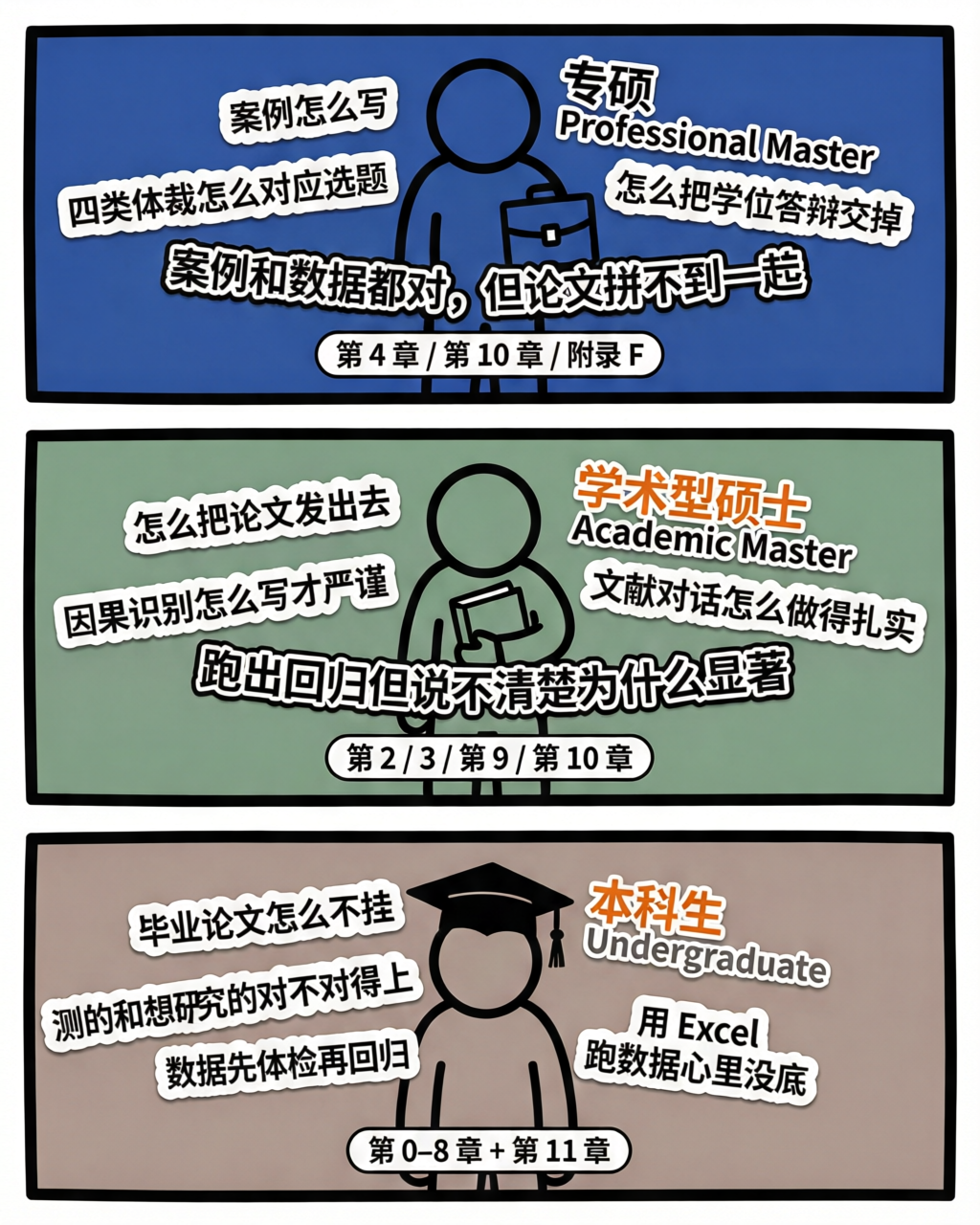
图 前-1 三类读者画像——专硕、学术型硕士、本科生各自关心的问题与读法。
配套资源
课程网站:本手册的网页版、各章资源与配套产出物模板不定期更新,见 https://2026ruralfinance.pages.dev。
CNB 项目库:源码、数据与文献库(
references.bib)托管于 https://cnb.cool/xiaosicau/2026ruralfinance,欢迎下载与反馈。
说明
本手册是面向没有编程基础的经管类研究生的通用经济研究参考手册。已有基础的研究生,可以把前两章当作环境与思维自查清单,直接进入方法主线。博士生和学者可把本手册当作文献综述与研究设计的操作参考。
本手册的编辑平台是 Qoder,并配置了 LaTeX 编译环境。在编撰流程上,AI 承担了 LaTeX 格式与语法检查、文献检索与著录核验、排版问题修复等技术性环节。本手册的编写过程本身就是一个“AI 时代研究”的实践样本:从初稿到定稿的十余轮迭代都在验证同一件事——AI 能把散落的知识组织成体系,但判断什么值得写、什么必须删、什么绝不能错,始终是人的工作。
这也是这本手册最想传达给读者的立场:把诚信当底线,把方法当主干,把 AI 当助手。
肖诗顺
2026 年 10 月 于四川农业大学
English Edition
Preface
Why This Handbook
Two facts stand before every student and researcher in the economics disciplines.
The first fact: the barrier to doing research has never been lower. A single sentence in natural language can prompt AI to generate complete code; a literature review that once took a month in the library can now be assembled in minutes by retrieval tools that summarize hundreds of papers and quickly identify research gaps.
The second fact: the risks to research integrity have never been greater. AI can produce empirical results that “look perfect”—the data may be fabricated, the statistical significance may be forced, and the references may be entirely invented.
This handbook is written at the intersection of these two facts: it teaches you where in the research workflow AI belongs—which steps encourage its use, which restrict it, and which forbid it—while helping you hold the line on method and integrity. The more powerful the tools, the more valuable method and integrity become. That is the first sentence of this handbook, and it is the through-line that runs across all twelve chapters.
A note on positioning: this is a general-purpose reference handbook for students and scholars in economics. What it teaches is general research methodology, applicable to all kinds of topics in economics and its applied fields. The running examples and deliverables use rural finance (agricultural insurance, digital inclusive finance, grain value-chain finance, and the like) as the primary application scenario—this is the author’s home turf in research, and it is also the field where beginners can most easily obtain data and produce research that speaks to real problems. Readers working on industrial economics, regional economics, public finance, capital markets, corporate finance, or international trade can apply the same methods and simply swap in their own cases.
What This Handbook Covers
The three words of the subtitle are the three pillars of the whole book.
Integrity (opening Chapter 0, then throughout): the red lines of research in the age of AI—what is permitted and what is never. Chapter 0 devotes itself entirely to drawing the bottom line: the AI risk points on Wallace’s wheel of science, the seven categories of plagiarism defined by Ministry of Education Decree No. 40, and five new types of misconduct added by the AI era. Every empirical operation in the chapters that follow—from data cleaning to robustness checks—is tied to one integrity discipline or another.
Methods (the main line of Chapters 2–11): a disciplined research workflow—from phenomena to research questions (Chapter 2), literature review and topic selection (Chapter 3), research design (Chapter 4), measurement and sampling (Chapter 5), data sources (Chapter 6), questionnaire design and fieldwork (Chapter 7), descriptive statistics (Chapter 8), inferential statistics and empirical strategy (Chapter 9), case study research (Chapter 10), and paper writing with AI disclosure (Chapter 11). The methodological framework benchmarks Bhattacherjee’s Social Science Research: Principles, Methods, and Practices.
Tools (woven through every chapter): an AI research toolchain—GLM conversational models, Zotero reference management, MCP data interfaces, and Stata/Python environments for empirical work. Tools are never for showing off; they exist to make methods land: the tool instruction in each chapter serves that chapter’s methodological task.
Three Conventions of This Handbook
Deliverable-driven. Each chapter has an explicit “deliverable”—
research_question.md,one_page_proposal.md,research_design.md, and so on. After reading all twelve chapters, you hold a complete research dossier rather than a pile of scattered notes. The full list of deliverables appears in Appendix C.Checkpoint self-audits. The handbook installs 23 S.X.Y integrity checkpoints (Appendix B), each a gate that either passes or does not—if it does not, go back and fix it; only when all gates pass is your research dossier ready for a defense or external review.
The three-tier classification of AI use. Across every research step, the handbook sorts AI usage into three tiers—permitted, must-disclose, forbidden (see Chapter 0, §0.3). Tool instruction and checkpoints in every chapter follow this same classification.
Three Kinds of Readers, Three Ways to Read
Professional master’s students: read the whole handbook. Chapter 4 (research design) and Chapter 10 (case study research) are the main battlefields of a degree thesis; the four thesis genres in Appendix F (product design / solution proposal / case analysis / survey report) map directly onto your topic.
Academic master’s students: read everything, and read deeply where it matters. Chapters 2, 3, and 10—theory building, engaging the literature, and case methods—are the foundations of publishing; the DID/RDD/PSM/IV identification strategies in Chapter 9 are the core competitive skill of an empirical paper.
Undergraduates (thesis / research training): Chapters 0–8 and Chapter 11 are required; Chapters 9–10 are optional. A bachelor’s thesis may never need difference-in-differences, but it will always need “does what you measure match what you intend to study” (Chapter 5) and “run a health check on the data before you regress” (Chapter 8).
Figure P-1 Three reader profiles—the questions and reading paths that professional master’s students, academic master’s students, and undergraduates each care about.
Companion Resources
Course website: the web edition of this handbook, chapter resources, and deliverable templates are updated from time to time at https://2026ruralfinance.pages.dev.
CNB project repository: source files, data, and the bibliography (
references.bib) are hosted at https://cnb.cool/xiaosicau/2026ruralfinance. Downloads and feedback are welcome.
A Closing Note
This handbook is a general reference on economic research written for graduate students in economics and management who have no programming background. Graduate students who already have the basics can treat the first two chapters as environment and mindset checklists and go straight to the methods main line. Doctoral students and scholars may use the handbook as an operational reference for literature reviews and research design.
The handbook was edited in Qoder with a LaTeX toolchain configured for the project. In the editorial workflow, AI handled the technical chores: LaTeX formatting and syntax checks, literature retrieval and citation verification, and typesetting repairs. The making of this handbook is itself a working specimen of “research in the age of AI”: a dozen rounds from first draft to final version all tested the same proposition—AI can organize scattered knowledge into a system, but deciding what is worth writing, what must be cut, and what must never be wrong remains the work of a human being.
That is the stance this handbook most wants to convey to its readers: treat integrity as the bottom line, method as the backbone, and AI as the assistant.
Xiao Shishun
October 2026 Sichuan Agricultural University